05 — Resilience & resume: what happens when things fail
This diagram is the failure story end to end: how damage is contained, what a failure cannot destroy, and what the destination is promised.
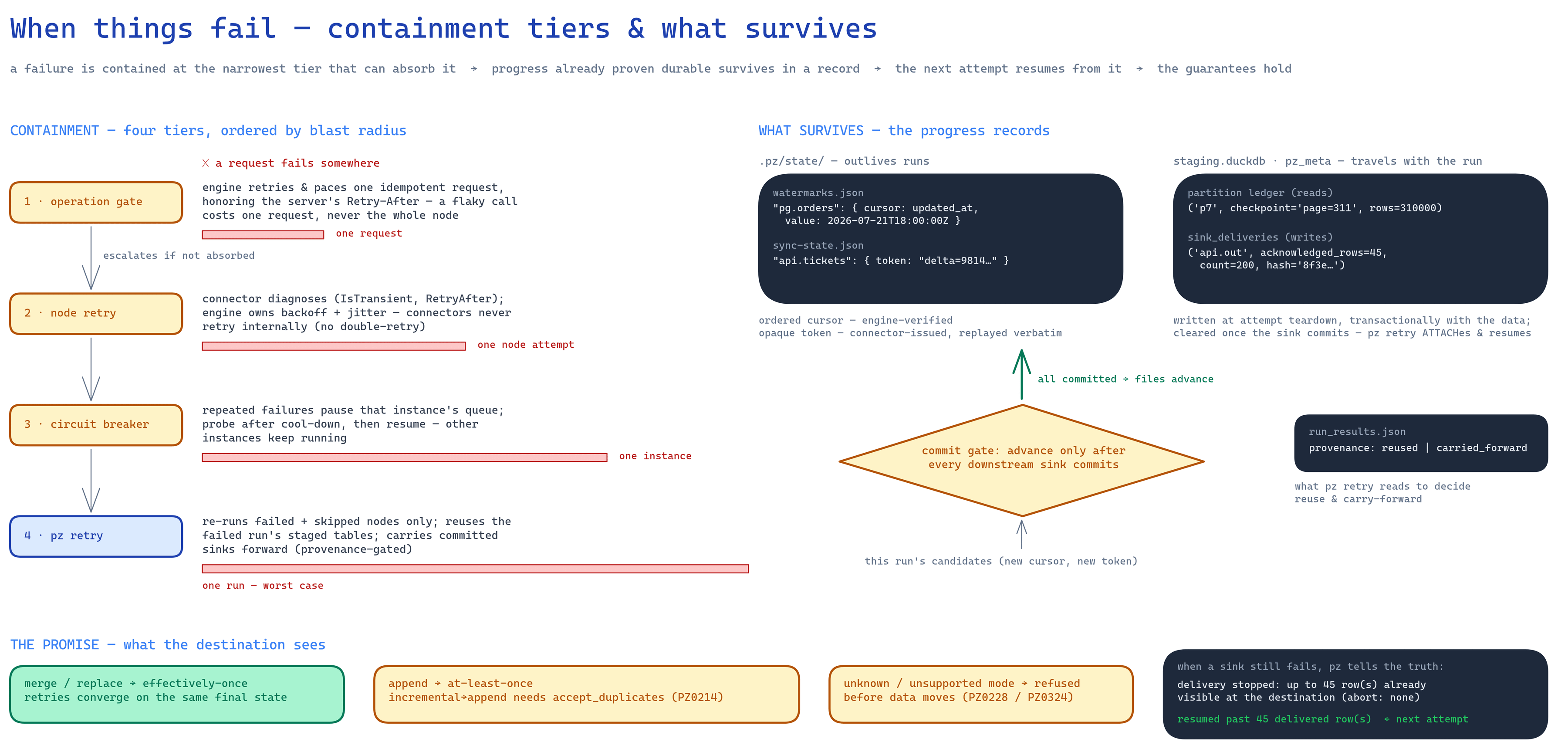
The summary strip at the top says it in one line: a failure is contained at the narrowest tier that can absorb it → progress already proven durable survives in a record → the next attempt resumes from it → the guarantees hold.
Reading the diagram
Section titled “Reading the diagram”Left: the containment ladder — four tiers, ordered by blast radius. The red bar under each row shows how much work a failure at that tier can cost you; it grows as you move down the ladder. Blast radius means exactly that: the most work a single failure can force you to redo.
- Operation gate — blast radius: one request. For connectors that opt in, the engine
retries and paces a single idempotent request (idempotent = safe to repeat; re-sending the
same request converges on the same result), honoring the server’s
Retry-After. A flaky HTTP call costs one request, never the whole node. The connector declares which operations are gate-safe; the engine does the retrying — connectors never retry internally. - Node retry — blast radius: one node attempt. The connector diagnoses the error (transient or permanent, and how long the server asked to wait); the engine owns the policy — attempts, exponential backoff, jitter. One diagnosis brain, one policy brain, never two retry loops multiplying each other.
- Circuit breaker — blast radius: one instance (one configured external system, e.g. “this SQL Server”). When a system is clearly dying, pz stops hammering it: its queue pauses, a probe fires after cool-down, work resumes on success. Every other instance keeps running the whole time.
pz retry— blast radius: one run, and even that isn’t paid twice. Retry re-runs only failed and skipped nodes, reuses the failed run’s staged tables, and carries already-committed sinks forward.
Right: what survives a failure. Containment is half the story; the other half is the progress records a failure cannot destroy. They live in two homes, chosen by lifetime:
.pz/state/— outlives runs (left card). Two files with different trust models but the same discipline.watermarks.jsonholds the watermark: an ordered cursor value the engine computed and verified from landed rows.sync-state.jsonholds the sync token: an opaque “call this next time” pointer the connector issued, which the engine stores and replays verbatim without inspecting it.staging.duckdb, schemapz_meta— travels with the run (right card). Mid-slice progress. On the read side: which partitions landed, and each partition’s checkpoint token (a page cursor stored after each durably staged chunk). On the write side: how many rows the destination actually acknowledged, fingerprinted against the content it was counted over. These ledgers are written in the same database transaction as the data they account for, so the ledger and the data can never disagree.pz retryattaches the failed run’s staging database and resumes from them.
Between the two sits the commit gate (the yellow diamond): every long-lived record passes
one rule — a candidate value advances only after every downstream sink for that dataset has
committed. A half-landed run advances nothing. That is why a crash can never strand a watermark
past data a sink never received. The ledgers in pz_meta have a different lifecycle on purpose:
they’re written at attempt teardown and cleared once the sink commits — they exist precisely
for the window when a run is incomplete.
The small run_results.json card completes the picture: the run receipt records each node’s
provenance (reused, carried_forward), and that’s what pz retry reads to decide what to
reuse and what to carry forward.
Bottom: the promise — what the destination sees. All the machinery above exists to keep three commitments:
- merge / replace → effectively-once. Retries converge on the same final state: a replayed merge upserts the same keys, a replayed replace overwrites with the same result.
- append → at-least-once. A replay can deliver a row twice, so pz makes you say so
explicitly: pairing an incremental dataset with an append sink requires
write: { duplicates: accept }, enforced at compile time (PZ0214). - A mode the sink can’t honor is refused before any data moves — an unknown mode at compile time (PZ0228), an unsupported one at plan time (PZ0324).
The terminal card at the far right shows the honesty rule: when a sink still fails mid-write, pz reports exposure truthfully — “delivery stopped: up to 45 row(s) already visible at the destination” — and the next attempt resumes past exactly those 45. Honesty first, then continuity.
Key points
Section titled “Key points”- Blast radius is a budget: one request, one attempt, one instance, one run — never more.
- Only proven progress survives: acknowledged rows, committed sinks, verified cursors.
- The ledger is written in the same transaction as the data — they can’t disagree.
- State advances only after every downstream sink commits.
- Honesty, then continuity: pz says what’s visible at the destination, then resumes past it.
Common questions
Section titled “Common questions”- Is the checkpoint machinery exactly-once? No, and pz won’t claim it. Resume delivers strictly after the acknowledged prefix, so nothing confirmed is ever re-sent — but a request the server processed without acknowledging (a timeout after the write landed) can be re-sent. That’s why the matrix says at-least-once for append; keyed merge absorbs the replay and gets effectively-once.
- What if the staged data changed between attempts? The delivery record carries a content fingerprint (row count plus an order-independent hash). If the relation isn’t the same multiset of rows, the recorded prefix means nothing and pz starts that sink from scratch. Resume never wins over correctness.
- Who writes the checkpoints — the connector or the engine? The engine owns every record on this diagram. Connectors only answer questions: “how many rows has the destination acknowledged?”, “can you resume from row N?”, “what’s your page token?” A connector that can’t prove its position doesn’t pretend — the fallback is always to re-extract or re-deliver a bounded slice.
- Why two state files instead of one? Different trust models. A watermark is engine-verified against landed rows; a sync token is connector-issued and opaque. Keeping them separate keeps the trust boundary visible; both advance through the same commit gate.
This is the last diagram in the set. The arc across all five: declare in YAML and SQL (01–02),
move data through the hub (03), dispatch and observe it (04), and survive everything that goes
wrong along the way (05) — none of it configuration you have to remember; it’s the default shape
of every pz run.