02 — Compile: YAML + SQL become a DAG
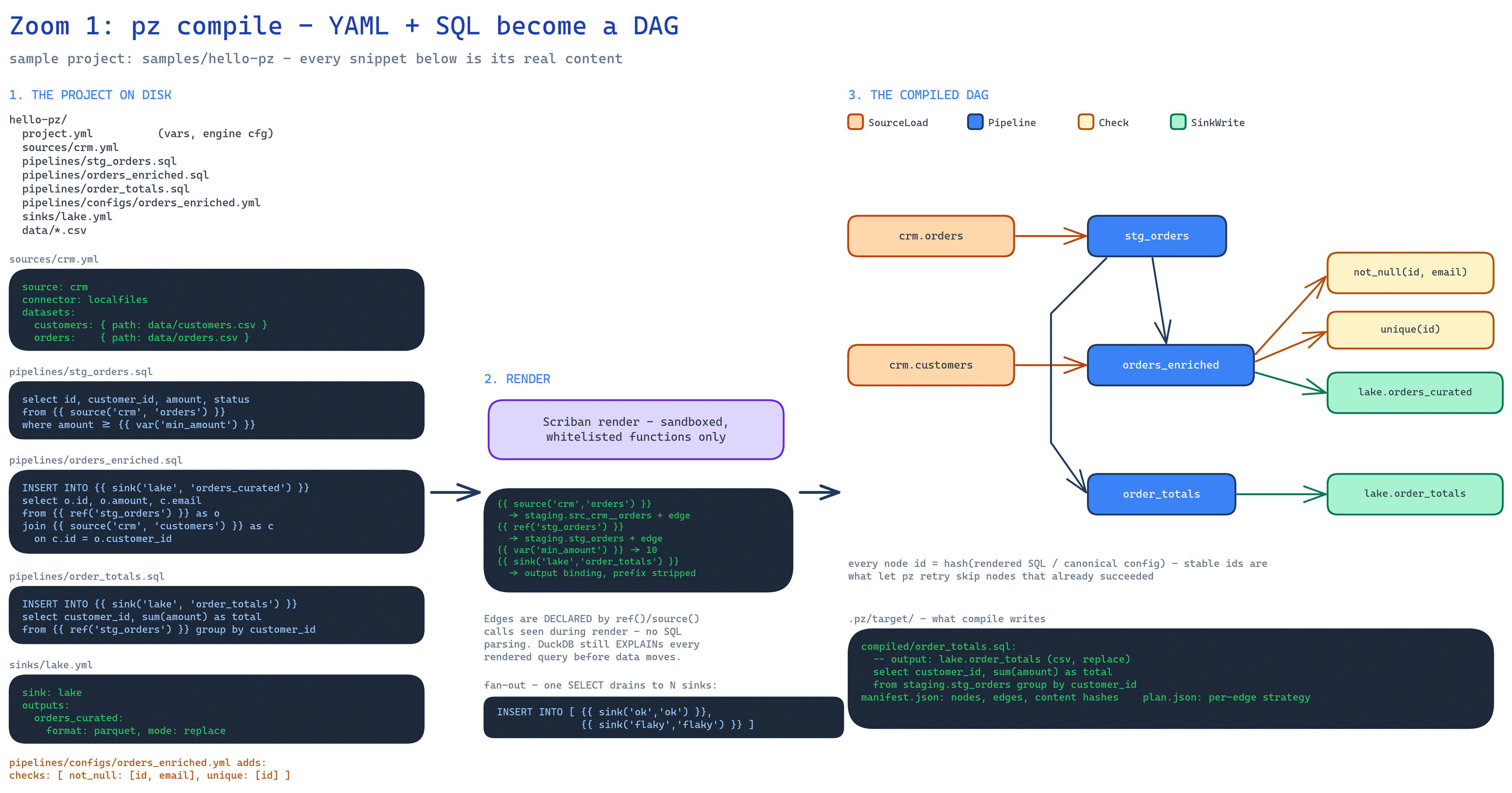
This diagram zooms into the first arrow of the overview: how pz compile turns project files
into a dependency graph, using the real templates/sample project verbatim — three tiny
CSV-backed pipelines, but the mechanism is identical at any scale.
A few terms:
- Template call — a
{{ ... }}placeholder inside a SQL file. Before the SQL ever runs, a template engine replaces each placeholder with real text (here: a concrete table name). The compiler watches which calls fire, and that’s how it learns the dependencies. - Edge — one arrow of the DAG: a data dependency, “this node’s output is that node’s input”.
- Rendering — filling in those placeholders. “Discovered at render time” means dependencies fall out of expanding the templates, not out of understanding SQL grammar.
- Deterministic — the same input files always produce byte-identical output, so compiled artifacts can be diffed and cached safely.
Reading the diagram
Section titled “Reading the diagram”Left column, top: the project on disk. Convention over configuration — every .sql file
under pipelines/ is a pipeline, named after its file, and every connection in
connections.yml is loaded. There is no central index of pipelines to keep in sync; dropping a file in the
folder is the registration.
Left column: the file snippets, in order.
connections.ymldeclares thecrmconnection and its entities — here two CSVs. An entity is one named table-shaped thing a source exposes (theordersCSV, say). This is whatsource()points at.stg_orders.sqlcontains{{ source('crm', 'orders') }}. That one call does two jobs: it resolves to a staging table name (the table in the run’s scratch DuckDB where that source’s data lands), and it declares a DAG edge.{{ var('min_amount') }}pulls a value fromproject.ymlvars — project-level configuration referenced from any template, so numbers like a threshold live in one place.orders_enriched.sqlusesref('stg_orders')— a pipeline-to-pipeline dependency, same mechanism — and opens withINSERT INTO {{ sink('lake', 'orders_curated') }}, which declares its load.order_totals.sqlshows the general shape: every pipeline names its own load inline, and the leadingINSERT INTO {{ sink(...) }}is the L of ETL. The insert is stripped at compile time; execution is still staged materialize-then-drain, never direct DML. That means the engine always writes the query result into a staging table first, then separately copies that table out to the destination — the query never writes to the destination directly. Why it matters: a half-finished query can never corrupt a destination, and one result can fan out to many sinks. So a single.sqlfile reads as the whole E→T→L:source()/ref()in theFROM, theSELECTas the transform,sink()in theINSERT.- The fan-out form: one transform feeding many sinks is an array —
INSERT INTO [ {{ sink(..) }}, {{ sink(..) }} ]. TheSELECTmaterializes once; each listed sink drains that one table. - the
lakeconnection is purely a place with credentials. It does not name its input; the producer is whichever pipeline’sINSERT INTOtargets the output. A pipeline that loads nowhere and nobodyref()s is a non-blocking warning (PZ0223), never a hard stop. (Every user-facing diagnostic in pz has a stablePZ####code, so it can be documented, searched, and suppressed deliberately.) - The checks note at the bottom: a sidecar config — a small YAML next to the
.sqlfile — attaches data-quality checks to a pipeline. A check is an assertion about the data (“this column is never null”, “ids are unique”), compiled into its own DAG node.
Middle: rendering. Templating is Scriban — a templating language for .NET, filling the role
Jinja fills for Python and dbt — running in a sandbox with a whitelisted function set: templates
can only call the handful of functions pz provides (ref, source, sink, var, …). No file
I/O, no network, no wall clock; one timestamp per run, so renders are stable within a run. This
is deliberately less than dbt’s Jinja, because that extra power is where dbt’s non-determinism
lives. The mapping box shows each {{ }} call and the text it becomes.
Dependencies come out of rendering for free, but they are not trusted blindly: DuckDB still
EXPLAINs every rendered query against an empty staging schema before any data moves.
(EXPLAIN asks the database to parse, bind, and plan a query without executing it — a dry run;
the staging tables exist with the right columns but no rows, so validation is instant.) Typos
and type errors die at validation, not mid-run.
Right: the compiled DAG. Four node kinds, per the legend: orange SourceLoads — one per
referenced dataset, so if you declare ten datasets and reference two, only two load; blue
Pipelines (one SQL transform each); yellow Checks, which run inside DuckDB where the data
already is, so they’re nearly free; green SinkWrites, which drain staging to destinations. You
can trace the sample’s edge chain: crm.orders → stg_orders → orders_enriched → lake.orders_curated.
Every node gets a content-addressed ID — a hash of its rendered SQL or canonical config. The
node’s identity is a fingerprint of what it does: if the SQL didn’t change, the ID didn’t
change, so a later run can prove “this node is identical to the one that already succeeded” and
skip it. That’s what makes pz retry (the verb that resumes a failed run) and incremental runs
coherent.
The artifacts box lists what compile writes: the rendered SQL, manifest.json (the full
node-and-edge graph as JSON), and plan.json (how each edge’s data will physically move —
diagram 03’s subject). All of it is inspectable before anything runs.
Key points
Section titled “Key points”- The template call is the dependency declaration — one mechanism, two jobs.
- If it compiles, it will very probably run: DuckDB validated every query before data moved.
- The manifest is table-level lineage for free — the “which data came from where” graph that auditors and data catalogs want.
Common questions
Section titled “Common questions”- What if I write SQL that references a table without
ref()? DuckDB’s dry-compile fails: the staging schema only contains declared objects. You can’t accidentally create hidden edges. - Are loops and conditionals available in templates? Yes — Scriban provides them over vars, still inside the sandbox.
- Why not parse the SQL to find dependencies? Parsing every dialect corner is fragile (a parser must understand all of every database’s SQL flavor; a template engine only has to expand its own placeholders). Render-time extraction is exact, and dbt has battle-tested the approach at huge scale.
Next: 03-data-plane — the DAG says what runs; how do the bytes actually move?