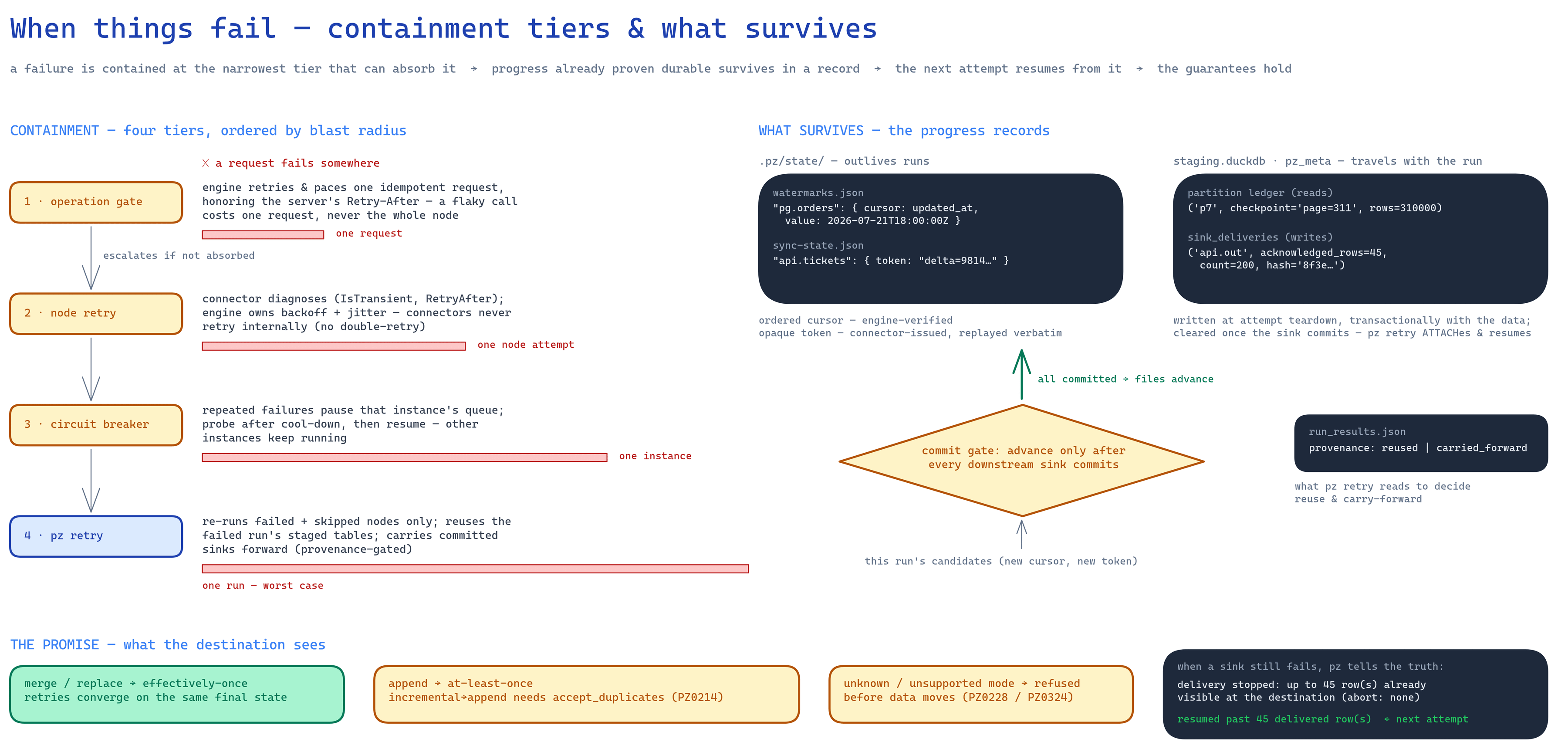
Delivery guarantees
This article states, as a stability contract, what guarantee each (read shape, write strategy)
pair actually provides when data is replayed — by a crash, a pz retry, or a re-run — and how
pz retry avoids manufacturing the duplicates that guarantee allows. If you’re deciding between
merge, replace, and append for an incremental or feed-shaped dataset, or you’ve hit
PZ0214/PZ0335, start here.
Declaring how data is read and written
Section titled “Declaring how data is read and written”A pipeline developer declares two intents, in one vocabulary each — see Project structure for the full YAML shapes and Connectors for how connectors implement them:
- How data is read — a dataset’s
sync:block.mode: incrementalis engine-owned, ordered-cursor tracking (cursor, plus the optionalmax_window/initial/untilwindow keys).mode: cdcis database-log change capture (Postgres pgoutput / SQL Server native cdc tables) — see Capture changes with CDC.mode: autois the default — the whole block may be omitted — and means the connector’s natural read: a stateless dataset re-reads fully, and a connector-managed change feed (an HTTP delta-link dataset, say) resumes its opaque token. - How data is written — an output’s
write:block:strategy: replace|append|merge,keys:(required formerge),duplicates: accept(the append consent below), andon_delete: delete|soft|ignore(cdc-fed merge outputs only — how a deleted source row is applied at the destination; see the how-to above).
At plan time every dataset resolves to exactly one read shape — full, feed, incremental,
or cdc — printed per SourceLoad in pz plan Reason strings (read=incremental cursor=<column>, read=feed, read=full, read=cdc; never connection/secret content). Declared
modes resolve to themselves; auto resolves to full or feed by asking the connector for its
natural read shape (a connector that doesn’t answer defaults to full) — so auto never hides
what will actually happen. The compiler and planner validate every (read shape, write strategy)
pair against the matrix below.
The pairing matrix
Section titled “The pairing matrix”| read shape ↓ / write → | replace |
append |
merge |
|---|---|---|---|
full |
✓ effectively-once | ✓ at-least-once | ✓ effectively-once |
feed |
✗ refused (PZ0335, until a snapshot-declaring feed capability exists) |
consent required — write: { duplicates: accept } (at-least-once) |
✓ effectively-once |
incremental |
✗ refused (PZ0335) |
consent required — write: { duplicates: accept } (at-least-once) |
✓ effectively-once |
cdc |
✗ refused (PZ0335) |
✓ effectively-once (on_delete: delete|soft); ✓ effectively-once upserts, deletes not propagated (on_delete: ignore) |
This table is a stability contract: the guarantee a cell provides today is the guarantee it
will keep providing, and every ✗ or unmet-consent cell is a PZ-coded, aggregate-reported compile
error naming the dataset, the output, and the fix. merge is safe to replay by construction —
a keyed upsert makes “the same slice landed twice” indistinguishable from “it landed once” — and
so is replace when it’s legal: a full overwrite means last write wins. append has no such
protection, whichever read shape feeds it.
incremental×replaceis a new refusal (PZ0335, previously silently legal): each run would replace the target with only the newest slice, discarding everything an ordered-cursor read relies on staying put across runs. The matrix makes this bug unrepresentable.feed×replaceis refused at plan time (PZ0335): a connector-managed feed’s read is not guaranteed to be a complete snapshot — replace would discard previously delivered rows. The refusal is unconditional this cycle; a future snapshot-declaring feed capability (aConnectorCapabilitiesflag by which a full-snapshot feed says “every read is complete”) would let such a feed legally replace.ExecutionPlannerraises it, because only the planner holds the opened connector and the dataset’s resolved read shape.cdc×replace/appendis refused (PZ0335,DagCompiler): a change-capture read is a stream of individual row events, not a re-readable full snapshot —replacewould discard every row not touched by the current window, andappendwould materialize raw change events (inserts and updates and deletes) as if they were all new rows.mergeis the only legal write strategy for acdc-synced dataset, and it must declareon_delete— see Capture changes with CDC.on_delete: delete/softroute the source table’s deletes to the destination (effectively-once: the merge is a keyed upsert, and a deleted key is either physically removed or timestamp-marked, either way idempotent under replay).on_delete: ignoreis upsert-only — a source-side delete never reaches the destination, so the destination accumulates rows the source no longer has; it’s still effectively-once for the rows it does write, but it is not a correctness-preserving mirror of the source table.- The
consentcells arePZ0214(below): at-least-once replay intoappendrequireswrite: { duplicates: accept }, whether the at-least-once read behind it is an explicitly declaredsync: { mode: incremental }dataset or an implicitmode: autodataset that resolves tofeed.
Below, the duplicate windows that make append at-least-once — real, reachable situations, not a
hypothetical edge case:
pz runafter a partial failure, instead ofpz retry. An operator who re-runs the whole project (rather than resuming withpz retry) re-extracts and redelivers to every sink, including ones that already committed.- A failed watermark persist. Watermark advancement is commit-gated (see Connectors) — if the store write itself never lands, the next run re-extracts the same slice.
- A partial
--selectthat omits a sink. Selecting a subset of the DAG can re-run a SourceLoad without re-running every sink that depends on it, or vice versa, depending on what’s in scope. - A reuse-fallback retry. When
pz retry’s staging reuse (below) falls back to re-extraction for a SourceLoad, its downstreamappendsinks receive a freshly-extracted slice that may not be byte-identical to the one already committed.
None of this makes append wrong — an append-only destination (an event log, a queue) may have
no other option, and a source with reliable pushdown filtering makes duplicates rare in practice.
It means append is at-least-once, and PipelineZ makes you say so.
Abort semantics
Section titled “Abort semantics”AbortAsync means different things for different destinations. A sink declares which one is true
for it (ISink.AbortSemantics), and the engine surfaces that declaration on failure instead of
leaving an operator to assume the historical “everything unwound” behavior:
| Value | What it means |
|---|---|
discards_all |
Abort removes every trace of the session’s writes (temp-write + discard-on-failure). This is the historical implicit contract every owned-destination sink has always had — every first-party sink that writes to a destination it owns (LocalFiles, S3, AzureBlob, Postgres, SqlServer) is DiscardsAll. |
best_effort |
Abort attempts cleanup but cannot guarantee it (independent deletes can fail); some written data may remain visible downstream. |
none |
Abort cleans up nothing — every delivered row is already visible downstream. Pz.Connector.Http is None: you cannot un-POST a request that already returned 2xx. |
The presence rule. A failed SinkWrite whose connector is not DiscardsAll reports a
delivery block instead of the plain failure message that used to imply cleanup happened:
delivery stopped: up to 340 row(s) already visible at the destination (abort: none)A DiscardsAll failure needs no such note — nothing survived the abort, so the plain node-failure
message already tells the whole story. See Run events for the
delivery field’s full shape in run_results.json/NDJSON.
RowsVisible is attempt-scoped. It counts only what this one attempt exposed at the
destination, not the destination’s cumulative state across every attempt so far: after a
scratched or declined resume on a non-DiscardsAll sink (the fingerprint mismatch and
decline-resume paths in Delivery checkpoints below), a later attempt
redelivers from row zero, so the rows an earlier attempt already left visible at the
destination are not reflected in the number this attempt reports — cumulative destination
exposure across attempts can exceed it.
Abort semantics are an orthogonal axis to the pairing matrix above, not a replacement for it:
merge/replace/append’s guarantees are per-strategy and unchanged by what a failed attempt’s
abort does or doesn’t clean up.
Partitioned output: per-partition atomic
Section titled “Partitioned output: per-partition atomic”An output combining a date-templated path with partition_by (see
Write partitioning) fans rows out into one blob per
partition folder instead of the single temp-blob promote a plain output uses. This section is about
that shape only — the one pz lays out. An output that declares partition_by with no calendar
tokens in path is partitioned by its destination (ColumnPartitionedWrites), and what a commit
there is atomic over is that store’s business, not pz’s: for a table format like Delta or Iceberg it
is normally the whole commit, which is a stronger guarantee than anything below. Each partition
folder promotes atomically and independently, so the write as a whole is not all-or-nothing
across the partition set: a run that fails partway through a partitioned write can leave a
subset of partitions committed and others not yet written; a re-run or pz retry reconciles
the rest. This composes with the matrix above rather than replacing it — each partition still
gets its folder’s own write-strategy guarantee (replace overwrites that folder atomically,
append is at-least-once for it) — so the write is at-least-once at the partition-set level,
the same “a slice may be revisited” shape as the append column above, one level up.
Staging every partition’s temp blob and promoting the whole set together was considered and rejected: “promote N blobs” is not itself atomic on an object store, so an all-or-nothing scheme would still leave a partial set observable to a crash mid-promote, and would need its own manifest/marker to make that set self-describing — more machinery for a guarantee it can’t actually deliver. Per-partition atomic is simpler and matches how other object-store partitioned writers (Spark/Hive-style) behave in practice.
PZ0214: incremental/feed → append requires consent
Section titled “PZ0214: incremental/feed → append requires consent”Compilation and planning refuse an incremental- or feed-shaped dataset feeding a
write.strategy: append output, unless the output opts in — the matrix’s two consent cells.
The check is split by which phase can see which case: an explicitly declared
sync: { mode: incremental } dataset is caught at compile time (DagCompiler, over the full
compiled DAG, never a --select-filtered subset, because the risk is a property of the project,
not of one run); an implicit mode: auto dataset that a connector resolves to feed can only be
known once the planner has the connector’s answer, so that case is caught at plan time
(ExecutionPlanner). Both report the same error, aggregated (never fail-one-at-a-time), naming
both ends and the file:
error PZ0214: sink 'lake.events_raw' has write.strategy: append and is fed by incremental dataset'crm.events' -- delivery is at-least-once, so a retried or replayed slice can duplicaterowshint: use write.strategy: merge (with keys:) or write.strategy: replace, or setwrite: strategy: append duplicates: accepton the output to accept at-least-once deliveryFix it by switching to merge/replace, or by declaring the reserved sub-key that records the
decision was made on purpose:
-- pipelines/stg_events.sqlINSERT INTO {{ sink('lake', 'events_raw', strategy: 'append', duplicates: 'accept') }}The consent sits on the load statement itself, so the pipeline and the guarantee it accepts are read together.
duplicates only accepts the literal 'accept'; anything else is a shape error at compile time
(a typo here should be loud, not silently ignored). Non-incremental, non-feed (full-shaped)
datasets are unaffected: a full re-extraction into append is a deliberate, visible-in-YAML
pattern with different semantics, not the case this rule targets.
[!NOTE] Compilation separately emits a non-fatal advisory notice for an explicit
sync: { mode: auto }dataset reaching a non-mergesink without consent — including areplacesink. It cannot fire for anincrementaldataset:PZ0335refusesreplaceandPZ0214refuses unconsentedappendfirst, so an incremental read never reaches a non-mergesink. The notice predates this page’s doctrine and speaks only in terms of “non-merge”, so it flags areplace-fedautodataset even thoughreplaceis effectively-once per the matrix above; treat it as a coarse legacy nag, not a correctness signal.write: { duplicates: accept }silences it the same way it silencesPZ0214— consent given once shouldn’t be nagged about twice.
PZ0335: incremental × replace is refused
Section titled “PZ0335: incremental × replace is refused”Compilation refuses an explicitly declared sync: { mode: incremental } dataset feeding a
write.strategy: replace output outright — there is no consent escape hatch, because there’s no
sense in which the pairing is ever intentional: each run would replace the target with only the
newest slice, discarding the whole point of tracking a cursor across runs.
error PZ0335: output 'lake.orders_curated': write.strategy 'replace' fed by incremental dataset'crm.orders' would discard previously loaded rows each run.hint: use write.strategy: merge (effectively-once), or remove the dataset's sync block for a fullre-readLike PZ0214, this runs over the full compiled DAG. It’s narrower than the matrix’s full
incremental × replace cell on paper — Pz.Core has no connector-capability access at compile
time, so an implicit mode: auto dataset that might resolve to feed is left to the planner,
which holds the opened connector and the resolved shape and refuses feed × replace with this
same code (see the matrix bullet above).
Sync state: another commit-gated state kind
Section titled “Sync state: another commit-gated state kind”Watermarks aren’t the only state a source can carry across runs. A feed-shaped dataset — no
sync: block, or an explicit mode: auto, resolved by the connector to feed (see
Connectors) — carries an opaque token instead of an orderable
cursor — a connector-issued “call this next time” pointer (a delta link, a change-feed cursor)
that the engine stores and replays verbatim without ever inspecting or comparing it. Sync state
shares the watermark model’s core discipline and its limits:
- Commit-gated advancement. The token only advances to
.pz/state/sync-state.jsonafter every downstream sink for that dataset has committed — the same ruleWatermarkAdvancementapplies to watermarks;SyncStateAdvancementandWatermarkAdvancementare thin wrappers over the one shared commit-gated walk (CommitGatedAdvancement), so the two state kinds can never drift apart on this rule. - At-least-once on replay. A retried or replayed run resumes from the last committed token,
which can re-deliver rows the token’s server already returned once. It carries the exact same
PZ0214consent requirement as an incremental dataset: pair a feed-shaped dataset withmerge(effectively-once) or declarewrite: { duplicates: accept }on anappendoutput. - Expiry is a distinct failure shape watermarks don’t have. An orderable cursor never goes
stale on its own; an opaque token can be expired server-side (e.g. HTTP 410 on a delta link).
That’s a permanent error naming
--full-refresh— which, for a feed-shaped dataset, means discarding the stored token and restarting the feed from its beginning, the sync-state equivalent of discarding a watermark. - Single-partition, opaque to the engine. Because the engine never parses the token, it can’t
merge or reconcile it across partitions the way it can compare cursor values — a feed-shaped
dataset is always single-partition (
PZ0316). There’s no separate mutual-exclusion rule to state here:sync:is one block with onemode, so a dataset can never resolve to bothincrementalandfeedat once.
SQL-declared incremental datasets and >= re-reads
Section titled “SQL-declared incremental datasets and >= re-reads”A dataset declared incremental in pipeline SQL with {{ watermark(...) }} (see
Incremental reads) carries the exact same
delivery semantics as a YAML-declared one — the watermark() form moves the declaration into
the SQL, not the machinery. The PZ0214 gate above applies identically: an SQL-declared
incremental dataset feeding a write.strategy: append output is a compile error unless the output
sets write: { duplicates: accept }, because the consent check keys off the dataset being
incremental, regardless of where that was declared.
One wrinkle is worth calling out. An inclusive lower bound — cursor >= {{ watermark(...) }},
including a lookback like >= {{ watermark(...) }} - interval 2 hour — re-reads the boundary
rows every run, because advancement always stores MAX(cursor) and the next run’s >= filter
includes that value again. That makes an inclusive read at-least-once by construction: a
merge sink dedupes the re-read rows on its keys, replace overwrites them, and an append
sink is subject to the same PZ0214 consent as any other at-least-once path. A strict > bound
reads each row once and has no boundary re-read.
How pz retry staging reuse works
Section titled “How pz retry staging reuse works”A successful pz retry used to be unable to advance the watermark at all: retry selects only the
prior run’s failed/skipped nodes plus their ancestors, so a sink that already succeeded is never
re-selected, and watermark advancement requires every structural SinkWrite descendant to be
present-and-succeeded in this run’s own results. That blocked advancement even after a fully
successful retry — and the next pz run would then re-extract the same slice and redeliver it to
every sink, duplicating rows in whichever ones were already committed. Retry staging reuse and
carried-forward sinks close that loop.
Reuse: copying instead of re-extracting
Section titled “Reuse: copying instead of re-extracting”For each SourceLoad, pz retry reuses the failed run’s staged table instead of re-extracting
when all of these hold:
- The prior run recorded that node
success, under the same content-hash node id present in the freshly recompiled DAG (the same id-matching rule retry already uses to pick up failed/skipped nodes). - The prior run’s
staging.duckdbstill exists (staging is retained by default when a run fails) and contains that node’s staging table. --full-refreshwas not passed — that flag keeps meaning “start the extraction over”, and disables reuse and carry-forward entirely.
When eligible, the executor copies the table before the connector is ever resolved — the source is never contacted for that node:
ATTACH '<prior run dir>/staging.duckdb' AS pz_prior_<node id> (READ_ONLY);CREATE OR REPLACE TABLE staging.<table> AS SELECT * FROM pz_prior_<node id>.staging.<table>;-- verify COUNT(*) matches the prior run's recorded row countDETACH pz_prior_<node id>;(the attach alias is derived from the node’s own id so that two SourceLoads reused concurrently
by the dispatcher never collide on a shared alias.) On success the node completes with
provenance: reused, its row count from the copy, and its watermark candidate re-materialized
under the retrying run’s id.
Fallback: never fail because reuse wasn’t possible
Section titled “Fallback: never fail because reuse wasn’t possible”Any guard failing — the row count not matching what was recorded, the table missing, or an
ATTACH/copy error (locked file, disk full) — drops whatever was copied and falls back to normal
extraction through the connector for that node, printing a note: naming the reason, for example:
note: source 'crm.events': prior run's staged table has 41 row(s) but 50 were recorded; re-extractingnote: source 'crm.events': staged data from the prior run could not be reused (<sanitized error>); re-extractingReuse is an optimization with a correctness bonus, not a new failure mode — a node that can’t reuse simply behaves exactly as retry did before this feature existed.
Only SourceLoad nodes are ever reused. Pipelines and Checks are always recomputed — they’re
cheap (in-DuckDB) and recomputation avoids any question about per-run template constants
(run_id, run_started_at) baked into their rendered SQL.
Partition checkpoints: the same fallback discipline, one level down
Section titled “Partition checkpoints: the same fallback discipline, one level down”A source whose partitions declare CheckpointableReads (see
Author a connector: partition identity and checkpoints)
resumes a failed partition mid-read instead of re-reading it from the start — inside a single
run’s attempt loop, or across a pz retry. This does not change the pairing matrix above.
Resume is strictly-after by contract: the engine only ever hands a connector a resume token
once every row it covers is durably staged, and before trusting that token it re-verifies the
staged prefix’s row count against the ledger. A rejected or torn checkpoint is never trusted
partway — it degrades to a full partition re-read from scratch, the same at-least-once shape
the matrix already accounts for. Either way, staged rows never double-land: a partition’s rows
move into the main staging table exactly once, in the same transaction as the ledger row that
marks it done.
Carried-forward sinks unblock watermark advancement
Section titled “Carried-forward sinks unblock watermark advancement”Before dispatch, pz retry also seeds the run’s results with carried-forward successes:
every SinkWrite that succeeded in the prior run, has an unchanged id in the recompiled DAG, and
— the soundness condition — has every SourceLoad ancestor being reused this retry (not falling
back to re-extraction), is recorded as an already-completed node with provenance: carried_forward. It is never dispatched, shows up as such in the console and NDJSON output, and
counts toward watermark advancement’s all-structural-sinks-committed rule. Because the soundness
condition guarantees every ancestor SourceLoad reproduces the prior slice byte-for-byte, the
carried-forward sink’s already-committed data is provably identical to what this retry’s other
sinks are working from — so a fully successful retry now advances the watermark, closing the
duplicate window described above.
If reuse fell back to re-extraction for any ancestor at execution time, the sinks downstream of
it remain recorded as carried forward in run_results.json and events (they genuinely committed
the prior slice), but that dataset’s watermark advancement is blocked — the engine checks at
advancement time that every carried-forward sink’s SourceLoad actually landed as reused, since
a re-extracted slice may not match the one the carried sink committed. The fallback path is never
worse than today’s behavior, only sometimes less optimal.
A retry that reuses and carries forward prints both counts:
note: reusing staged data for 2 source load(s) from run 20260710T120000000Z-ab12note: carrying forward 1 committed sink write(s) from run 20260710T120000000Z-ab12provenance in artifacts and events
Section titled “provenance in artifacts and events”Both run_results.json and the node_completed NDJSON event (see Run events)
carry an optional provenance field on any node it applies to — absent for normally-executed
nodes, so pre-existing artifacts and event lines stay byte-identical:
"reused"— a retriedSourceLoadwas satisfied by copying the failed run’s staged table instead of re-extracting."carried_forward"— aSinkWritethat committed in the prior run was recorded into this retry’s results without being re-run.
A reused SourceLoad’s run_results.json entry also carries its watermark object (cursor,
type, value) — the slice identity the reuse inherited, re-stamped with the retrying run’s id
rather than the failed run’s.
Delivery checkpoints
Section titled “Delivery checkpoints”A sink whose connector declares CheckpointableWrites gets an engine-owned delivery
ledger — pz_meta.sink_deliveries, a table inside the run’s staging.duckdb, tracking how many
drain-order rows the connector has durably confirmed for that node. The engine drains the sink’s
input with order by all (a content-deterministic order, so the same relation content always
produces the same row prefix) and, after each batch, asks the checkpointing session how many rows
it has confirmed so far. At attempt teardown — success or failure — the acknowledged count is
persisted alongside a count+hash fingerprint of the drained relation’s content; a later attempt
(the same run’s retry loop, or a later pz retry carrying the staging DB forward through its
ATTACH mechanism) reads that row, re-fingerprints the relation, and — only when both the row count
and the content hash still match — resumes the drain past the acknowledged prefix instead of
re-delivering from row zero. Any mismatch (a changed relation, an unreadable prior, a declined
resume) scratches the row and falls back to a full re-drain, the same safe direction a rejected
partition checkpoint falls back to (above).
Checkpoints narrow the duplicate window; they do not change the pairing matrix. append
stays at-least-once even with checkpointing engaged: only connector-confirmed counts ever enter
the ledger (TryGetAcknowledgedRows may only report rows the destination has actually
acknowledged), so a resume never skips a row the destination hasn’t seen — but a crash between the
destination’s acknowledgment and the ledger write still re-delivers that unrecorded tail on the
next attempt. What checkpointing buys is a smaller duplicate window (the last unrecorded batch
or two, instead of the whole relation from scratch), not a different row in the table at the top
of this page.
Write attempt identity
Section titled “Write attempt identity”Every SinkWrite reaching a connector through the universal tier carries OutputSpec.Attempt, so a
sink can tell which attempt at which write it is executing rather than inferring it:
| Field | What it identifies |
|---|---|
Node |
the output being written — the content-addressed node id |
Run |
the run the attempt belongs to |
Ordinal |
which attempt within that run, counting from 1 |
What it promises. Node and Run are stable across every attempt within one run, and
Ordinal increments. A sink whose destination can record a durable progress marker — a commit
property, an application id, a row in a ledger table it writes transactionally with the data — can
therefore stamp one on commit, read it back at the start of the next attempt, and skip work a
previous attempt already committed. That closes the duplicate window append actually suffers from
in practice: a commit that reached the destination and then failed to be reported back to pz.
What it does not promise. Nothing here spans runs. A second pz run is a new Run, and a
marker written under the old one will not match — so do not build a cross-run dedupe on it. Bounding
it this way is deliberate: cross-run identity would have to be threaded through run_results.json
and every run-artifact backend, and a primitive that is silently unreliable in one backend is worse
than one whose limit is stated.
Where it is stamped. Only past the native-copy decision. A native COPY has no write session to
carry a marker, and the spec a connector is probed with by TryGetNativeCopy has to be the spec the
planner probed with — so Attempt is absent on that path rather than misleading. It is additive: a
connector that ignores it behaves exactly as before.
What’s still deferred: connector-side exactly-once append
Section titled “What’s still deferred: connector-side exactly-once append”Staging reuse and carried-forward sinks close the specific duplicate window where a fully
successful pz retry couldn’t advance the watermark, and the delivery checkpoints (above)
narrow the re-delivery window for connectors that opt in. Neither makes append effectively-once
in general — the other duplicate windows in the pairing matrix above (a pz run instead of a
pz retry, a failed watermark persist, a partial --select, or a reuse fallback mid-retry) still
apply, and even a checkpointed sink can re-deliver its last unconfirmed batch on a crash.
Attempt identity hands a capable sink what it needs to close the
within-run case itself, which is the common one; it deliberately stops there. Closing
those for good needs a connector-side idempotency mechanism — a slice ledger (_pz_slices)
written in the same transaction as the data itself, for every sink connector — and that half of
the design stays deferred: it touches the connector ABI and every sink connector, so it’s scoped
as its own follow-on design rather than bundled here.
HTTP sink
Section titled “HTTP sink”Pz.Connector.Http’s sink is the vertical driver for the write-mode
and checkpoint work — see Extract from an HTTP API for its
full configuration surface. Its delivery posture:
append— chunked row-array (or NDJSON) requests; at-least-once, same as any otherappendsink — thePZ0214consent gate applies identically when it’s fed by an incremental or windowed dataset.merge— one keyedPUT/PATCHrequest per row (exactly one key column in v1); rows are effectively-once, since a replayed request is an idempotent overwrite at the destination — the same slice landing twice is indistinguishable from landing once.replace— refused at plan time (PZ0324): the connector does not declareReplaceWrites, since there is no way to atomically overwrite an arbitrary HTTP endpoint’s prior state.
Its abort semantics are none — you cannot un-POST — and it declares CheckpointableWrites, so a
retried attempt resumes past its acknowledged prefix per the section above rather than re-sending
every row.
Next steps
Section titled “Next steps”- The execution model — the eight phases and how
pz retryfits in. - Connectors — watermarks and commit-gated advancement in full.
- Run events — the
node_completedevent’s full field list, includingprovenance. - Run checks and retry failures — the operator-facing retry workflow.