7. Data validation and quality
There are two ways a pipeline can fail. It can crash - loud, obvious, fixed by breakfast. Or it can succeed with wrong data - silent, invisible, discovered three weeks later by the owner asking why the dashboard says a bakery sold negative croissants. The second kind is worse in every way that matters: wrong numbers drive wrong decisions and, once caught, poison trust in every right number the pipeline ever produced.
Data validation is how you convert failures of the second kind into failures of the first.
Where bad data comes from
Section titled “Where bad data comes from”Not, usually, from your code. The recurring culprits:
- Humans upstream. A clerk fat-fingers
2,400.00instead of24.00. A test order from the staff party lands in production data. - Systems upstream. An app deploy starts writing
NULLcustomer IDs for guest checkouts. The API starts returning amounts in cents where it used to send euros. - The pipeline’s own seams. An at-least-once retry delivers the same rows twice (article 4 warned you). A join you assumed was one-to-one is quietly one-to-many, and row counts double.
- Time. Timezone drift, daylight saving, late-arriving records landing in last week’s totals.
Notice the pattern: none of these throw errors. Every one of them flows through an unguarded pipeline and comes out the other side looking like data.
Checks: assertions about data
Section titled “Checks: assertions about data”The fix is the same idea software engineers use everywhere - assertions - pointed at data instead of code. A check is a rule the data must satisfy; the run fails (loudly!) when it doesn’t. A small vocabulary covers most real-world damage:
| Check | Plain meaning | The disaster it catches |
|---|---|---|
not_null |
This column always has a value | Guest-checkout NULLs making revenue vanish from customer reports |
unique |
No two rows share this value | Duplicated orders doubling revenue |
accepted_values |
Only these values allowed | A new 'refunded' status silently uncounted by old logic |
| relationship | Every value exists in that other table | Orders pointing at customers the CRM extract missed |
| range | Value between sensible bounds | The €2,400 croissant; negative amounts |
| freshness | Newest row is recent enough | The extraction that’s been silently pulling nothing for a week |
| volume | Row count in a plausible band | The half-empty extract from a source that hiccuped mid-pull |
The last two deserve emphasis because they’re the ones beginners skip: freshness and volume checks catch problems in the pipeline itself, not just in the rows. “Zero new orders on a Saturday” is technically valid data and almost certainly a broken extraction.
In modern tools these are one line of configuration next to the transformation they guard:
# checks on the orders_enriched tablechecks: - not_null: [id, email] - unique: [id]One line. Compare that to the cost of the failure it prevents, and data validation becomes the best deal in this series.
Where to put checks: the seams
Section titled “Where to put checks: the seams”Checks belong at the boundaries - the same layer seams article 5 built:
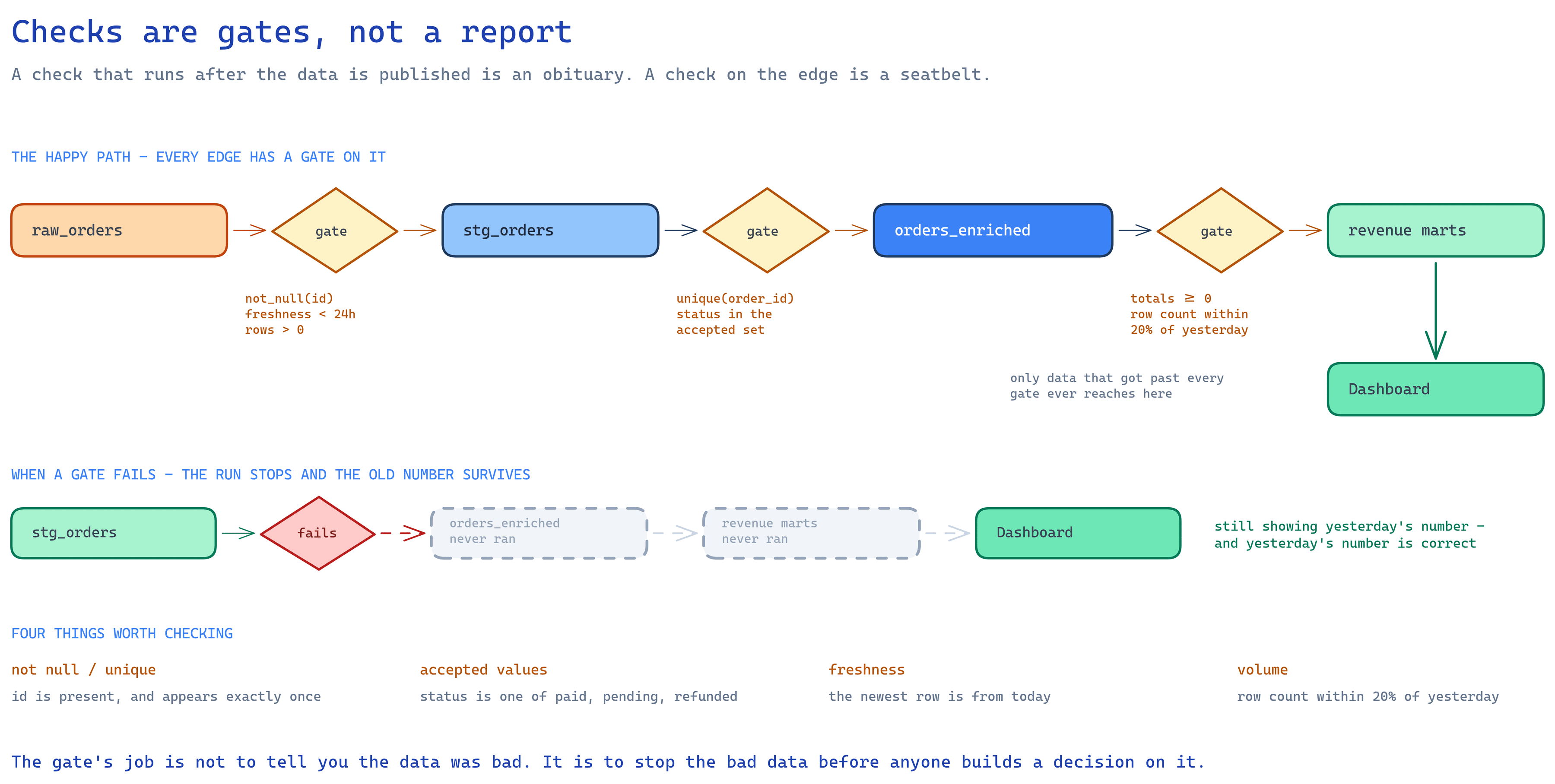
- At ingestion - validate what the source sent, before anything transforms it. This is
where schema expectations (article 4’s drift posture) live: is
amountstill a number? - After each transformation layer - validate what you made.
unique order_idafter staging’s dedup proves the dedup worked; a row-count comparison across a join catches the one-to-many surprise on the night it appears. - Before the final load - the last gate before numbers become visible. The cardinal rule sits here: a table that fails its checks should never reach the dashboard. In DAG terms (article 6): checks are nodes, and the final write depends on them passing.
Checks-as-DAG-nodes is the elegant bit - no new machinery. A failed check behaves exactly like a failed step: its downstream cone is skipped, everything independent completes, and the run reports honestly.
Fail or warn? Calibrating severity
Section titled “Fail or warn? Calibrating severity”Not every rule deserves to stop the presses:
- Fail when acting on the data would be worse than not having it: duplicate order IDs, negative revenue, an empty orders extract. Blocking beats publishing fiction.
- Warn when the data is imperfect but usable: 2% of orders missing a store assignment. The run continues; the issue is logged and visible, and stakeholders see numbers with a known caveat instead of no numbers.
Two failure modes to steer between: check nothing (silent corruption flows freely) and fail on everything (the dashboard is down weekly for trivia, and people start ignoring red - the worst outcome of all, because ignored alarms are how the real one gets missed). A useful calibration question: “if this rule breaks, should the owner see no data or this data?” Let the answer pick the severity.
A refinement for the warn-ish middle ground: quarantine. Route rows that fail a check
into a side table (orders_quarantine) instead of dropping or passing them - the 98% good
rows flow on, the 2% weird ones wait, visible, for a human. Nothing silently vanishes,
which is the property you’re really buying.
Beyond checks: contracts and reviews
Section titled “Beyond checks: contracts and reviews”Two habits extend validation past the run itself:
- Data contracts - an explicit agreement with the producer: “the orders table has
these columns, these types;
idis unique; you’ll warn us before changing it.” Even informally agreed and enforced by your ingestion-time checks, a contract transforms the conversation from “your dashboard is broken” to “the source broke the contract on Tuesday” - with receipts. - Test data changes like code changes. When you edit the revenue logic, run the old and new versions side by side and diff the totals before shipping. Checks guard against bad data; this guards against bad logic, which checks can’t see.
Sunrise Bakery, guarded
Section titled “Sunrise Bakery, guarded”The night the shop deploys guest checkout, the pipeline fails at 06:04:
not_null check failed: customer_id - 47 of 512 rows null (stg_orders). The dashboard
shows yesterday’s trusted numbers with a “data delayed” note. By 09:30 the team has decided
guest orders are real revenue, added a guest placeholder customer, adjusted the check,
and rerun. Total cost: one morning coffee’s worth of delay - and the owner never saw a
wrong number. That is data validation working exactly as designed: the crash you
configured, instead of the silent lie you didn’t.
The takeaway
Section titled “The takeaway”- The dangerous failure is the silent one; checks convert it into a loud one.
- A small vocabulary - not_null, unique, accepted values, relationships, ranges, freshness, volume - catches most real damage for one line of config each.
- Put checks at the seams: ingestion, after each layer, and as a gate before anything user-visible. Checks are DAG nodes; failed checks block their downstream.
- Calibrate fail vs warn deliberately; quarantine the borderline rows.
- Trust is the product. Checks are how a pipeline earns it back every single night.