5. Transforming data
Extraction and loading move data; transformation is where the value is created. It’s the step that turns “487,312 rows of raw records” into “revenue was up 4% last week, driven by the new sourdough line.” This article is about doing that reliably - which turns out to be less about clever SQL and more about organizing SQL.
What transformation actually consists of
Section titled “What transformation actually consists of”Underneath the fancy names, transformation is a small set of verbs applied over and over:
- Cleaning - fixing what’s wrong: trimming stray whitespace, unifying
"SHIPPED"/"shipped"/"Shipped", handling missing values, removing the duplicate rows that ingestion’s at-least-once world allows. - Typing - turning strings into real types:
"2026-03-01"into a date,"24.00"into a number. (CSV, remember, has no types.) - Standardizing - one vocabulary across sources: the shop says
customer_id, the CRM sayscontact_ref; pick one name and rename at the door. - Joining - connecting datasets: orders to customers, payments to orders. This is where data starts becoming answers.
- Aggregating - summarizing: revenue by store by day, orders per customer.
- Deriving - new facts from old:
amount - discountasnet_amount, a customer’s first order date, a “weekend/weekday” flag.
Why SQL won
Section titled “Why SQL won”You can transform data in any language, and sometimes should (heavy text parsing, ML features). But for tabular data, SQL has quietly won, for reasons worth spelling out:
- It’s declarative - you state the result you want (“orders joined to customers, summed by day”), and a highly optimized engine figures out how. Less code, fewer bugs.
- It’s the most shared skill in data - the analyst, the engineer, and often the stakeholder’s finance person can all read it. Transformation logic in SQL is logic the whole team can audit.
- It runs where the data is - inside the warehouse or engine, instead of dragging millions of rows into an application to loop over them.
The modern transformation layer is therefore mostly SQL files under version control, run
by a tool that knows their order. (dbt made this shape famous; pz in Part II is the same
shape.)
One big query, and why it fails
Section titled “One big query, and why it fails”Here’s the tempting way to build Sunrise Bakery’s revenue report - everything in one query:
SELECT s.store_name, DATE(o.created_at) AS day, SUM(o.amount - o.discount) AS revenueFROM (SELECT *, ROW_NUMBER() OVER (PARTITION BY id ORDER BY updated_at DESC) rn FROM raw_orders WHERE status NOT IN ('cancelled','CANCELLED','Cancelled')) oJOIN raw_stores s ON s.id = o.store_idJOIN (SELECT DISTINCT contact_ref AS customer_id, region FROM raw_crm_contacts) c ON c.customer_id = o.customer_idWHERE o.rn = 1 AND o.amount IS NOT NULLGROUP BY s.store_name, DATE(o.created_at);It works - today. But deduplication, status-cleaning, CRM renaming, joining, and aggregating are all tangled into one artifact. When “revenue” needs a second report (by region this time), you copy-paste the query, and now the cancelled-order rule lives in two places. Six months later someone fixes it in one. Congratulations: two dashboards now politely disagree about revenue, and nobody knows which is right.
The layered fix
Section titled “The layered fix”Article 3 introduced the pattern; here it is doing its job. Break the one query into small steps, each materialized as its own table, each reading only the layer before:
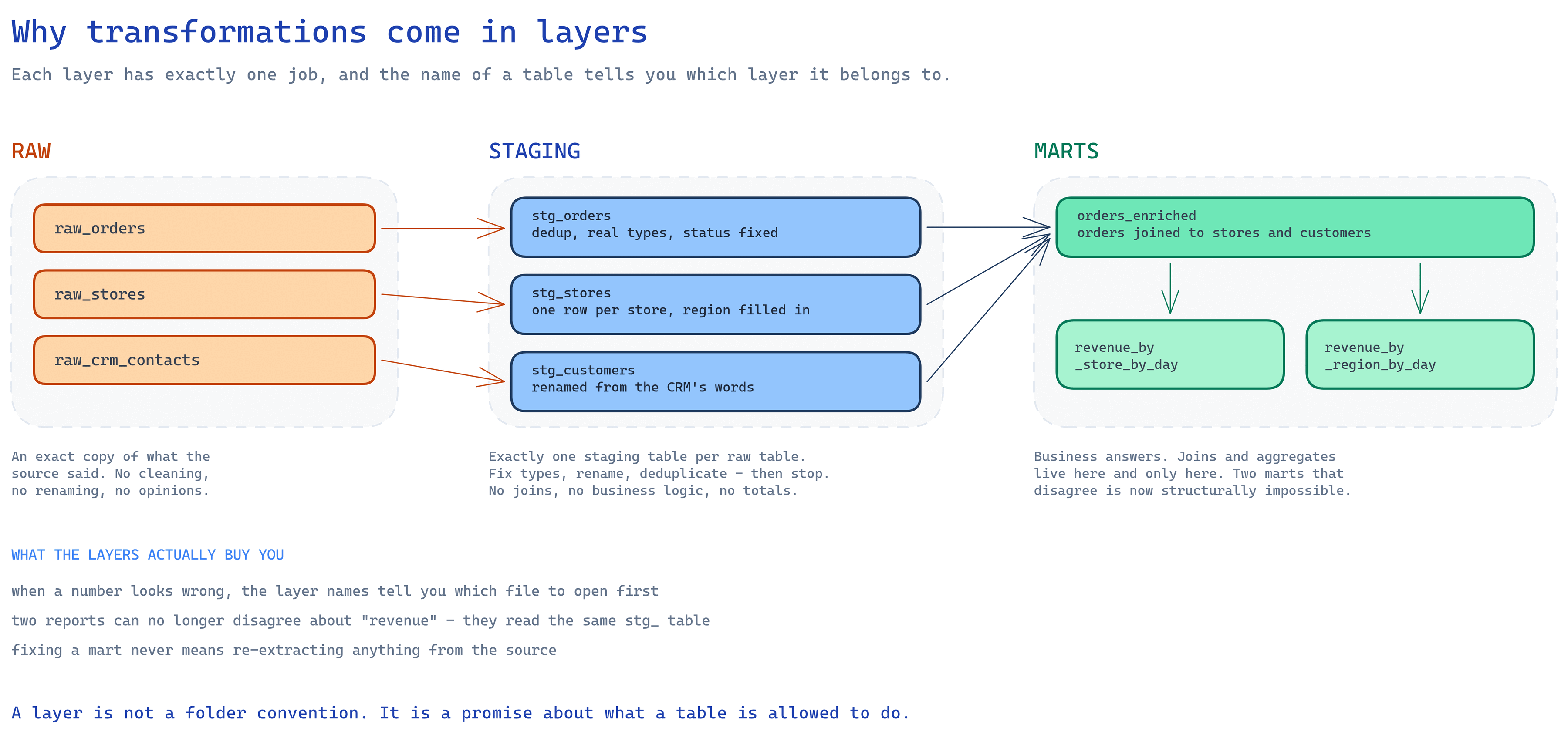
Each staging file is short and boring - and boring is the compliment:
-- stg_orders.sql: one row per order, cleaned. No business logic.SELECT DISTINCT ON (id) id AS order_id, customer_id, store_id, CAST(amount AS DECIMAL(10,2)) AS amount, LOWER(status) AS status, CAST(created_at AS TIMESTAMP) AS created_atFROM raw_ordersORDER BY id, updated_at DESC;The payoffs compound:
- One definition, one place. The cancelled-order rule lives in
stg_orders. Both revenue marts inherit it automatically. The two-dashboards-disagree failure becomes structurally impossible. - Testability. You can check
stg_ordersfor duplicate IDs before anything joins to it (article 7 lives at these seams). - Debuggability. When a number looks off, you walk the chain - is it wrong in the mart?
In
orders_enriched? In staging? In raw? Each hop narrows the suspect list. - Cheap change. The by-region mart was a new 10-line file, not a copy-paste.
The cost is real but modest: more files, more (usually cheap) intermediate tables, and the discipline to put logic in the right layer - cleaning in staging, business rules in marts, nothing reaching backward.
Habits that keep transformations sane
Section titled “Habits that keep transformations sane”- Name things by convention.
stg_for staging, plain business names for marts; the same key gets the same name everywhere (customer_id, nevercust_refpast staging). A stranger should be able to guess a table’s layer from its name. - Make transforms deterministic. The same inputs must produce the same outputs, every
run. The classic sin is
WHERE created_at > NOW() - INTERVAL '7 days'- its answer changes by the second, reruns can’t reproduce yesterday, and backfills become guesswork. Compute “as of when?” once, outside the SQL, and pass it in. - Rebuild, don’t patch. Each run rebuilds tables from upstream data rather than editing them in place. Combined with article 4’s idempotent loads, this is what makes rerunning a failed night a non-event instead of surgery.
- Comment the why.
status <> 'test'deserves a note about the day the staff seeded fake orders; the next reader can’t guess that from the code.
Where transformation runs
Section titled “Where transformation runs”A last practical note: layered SQL needs an engine to run in. In warehouse-centric stacks that’s the warehouse itself. In lighter setups a tool brings its own engine - DuckDB being the notable one: a fast analytical engine that runs inside the tool’s own process, no server to install. Data lands in it, the SQL layers run there at columnar speed, and the results are written onward. Same layered pattern, no infrastructure. Hold that thought for Part II.
The takeaway
Section titled “The takeaway”- Transformation is cleaning, typing, standardizing, joining, aggregating, deriving - and SQL is its shared language for good reasons.
- One big query rots; small layered steps (raw → staging → marts) keep every rule defined exactly once, testable at the seams, and traceable when questioned.
- Determinism and rebuild-don’t-patch are what make transformations safely rerunnable.
- Metrics people trust come from definitions that exist in exactly one place.