4. Data ingestion: extracting and loading
Ingestion is the E and L of the story: getting data out of systems that were never designed to give it up, and putting it down somewhere without losing, duplicating, or mangling it. It’s the least glamorous layer of the platform and the one where most real-world failures happen - sources are the part of a pipeline you don’t control.
Connectors: one adapter per kind of source
Section titled “Connectors: one adapter per kind of source”You could write custom code for every source. The second time you do it, you’ll notice you’re solving the same problems again: connect, authenticate, page through results, retry on hiccups, map the source’s types to yours. A connector packages those solutions per kind of source - one for Postgres, one for SQL Server, one for local files, one for S3 - so adding a source becomes configuration:
shop_db: connector: postgres host: db.sunrisebakery.com database: shopThink of connectors as power adapters: the wall sockets differ by country, the appliance doesn’t care. Every serious pipeline tool is, in large part, a connector collection plus the machinery to run them.
Extracting from databases
Section titled “Extracting from databases”The straightforward part: databases speak SQL, so extraction is a query. The craft is in not hurting the source:
- Extract off-peak - the 06:00 batch slot exists because 06:00 is quiet.
- Extract incrementally (article 3):
WHERE updated_at > <watermark>turns a million-row scan into a thousand-row read. The watermark must be stored durably between runs, and it should only advance after the data it covers is safely delivered - if you advance it and then crash before writing, those rows are simply gone. This ordering - deliver first, then advance - is one of the classic subtle bugs of ingestion. - Split big extractions into partitions - four parallel readers each taking a slice of the ID range finish faster and hold shorter locks than one giant query.
- Push work down. If the pipeline only needs three columns and last week’s rows, ask the source for exactly that instead of dragging everything across the network and filtering later. This is called pushdown (of projections - columns - and predicates - filters), and good tools do it for you.
Extracting from APIs
Section titled “Extracting from APIs”SaaS tools hand you HTTP endpoints instead of SQL, and three realities come with them:
- Pagination. APIs return results a page at a time (
?page=7or a “next” token). The extractor must loop until the pages run out - and cope with data changing while it pages. - Rate limits. The provider will throttle you (“429 Too Many Requests - retry after 30 seconds”). Polite extractors slow down and resume rather than hammering on.
- Shape. You get nested JSON, not tables. Part of ingestion is flattening
customer.address.cityinto columns.
APIs fail more than databases - timeouts, 500s, maintenance windows. Which brings us to the most important behavior in this article.
Retries, and the difference between hiccups and bugs
Section titled “Retries, and the difference between hiccups and bugs”Failures come in two species, and they deserve opposite treatment:
- Transient failures - a timeout, a dropped connection, a rate limit - fix themselves. The right response is to wait and retry, with growing pauses (2s, 4s, 8s - exponential backoff) so a struggling source gets air instead of a stampede.
- Permanent failures - bad credentials, a table that doesn’t exist, malformed config - will fail identically every time. The right response is to stop immediately and tell a human, loudly and specifically.
A pipeline that retries permanent errors wastes hours before failing anyway; one that doesn’t retry transient errors pages a human at 3 a.m. for a 10-second network blip. Distinguishing the two - and capping retries so a persistently transient failure (a source that’s down all night) eventually stops burning the budget - is table stakes for ingestion.
File formats: how data travels and rests
Section titled “File formats: how data travels and rests”Extracted data has to be written down somehow. Three formats cover almost everything:
| Format | What it is | Best at | Watch out for |
|---|---|---|---|
| CSV | Plain text, one row per line | Universal exchange - everything reads it | No types: 007 and 2026-03-01 are just strings; commas and quotes inside values bite |
| JSON | Nested text records | API payloads, irregular shapes | Verbose; still typeless-ish |
| Parquet | Binary, columnar, compressed | Analytics: small files, fast scans, real types | Not human-readable |
Rule of thumb: accept CSV and JSON at the edges (they’re what sources give you), store in Parquet once data is yours. A Parquet file is routinely 5–10× smaller than the same CSV and far faster to query, because readers can grab single columns and skip whole chunks.
Schema drift: sources change without asking
Section titled “Schema drift: sources change without asking”One Tuesday the shop’s developers rename amount to total_amount and add a channel
column. Nobody tells the data team - nobody ever tells the data team. This is schema
drift, and ingestion sits directly in the blast radius.
The spectrum of responses, from strict to loose:
- Fail loudly on any unexpected change. Safest default: wrong-but-obvious beats wrong-but-silent, which is the villain of this whole series.
- Tolerate additions (new columns flow through or are ignored) but fail on removals and type changes - a pragmatic middle.
- Auto-adapt to everything. Comfortable until the day a renamed column silently becomes a column of NULLs feeding a correct-looking, wrong dashboard.
Whichever you choose, choose it explicitly, per source. Declaring expected columns and types up front is what turns drift from a silent corruption into a clear morning error.
Loading: the three strategies
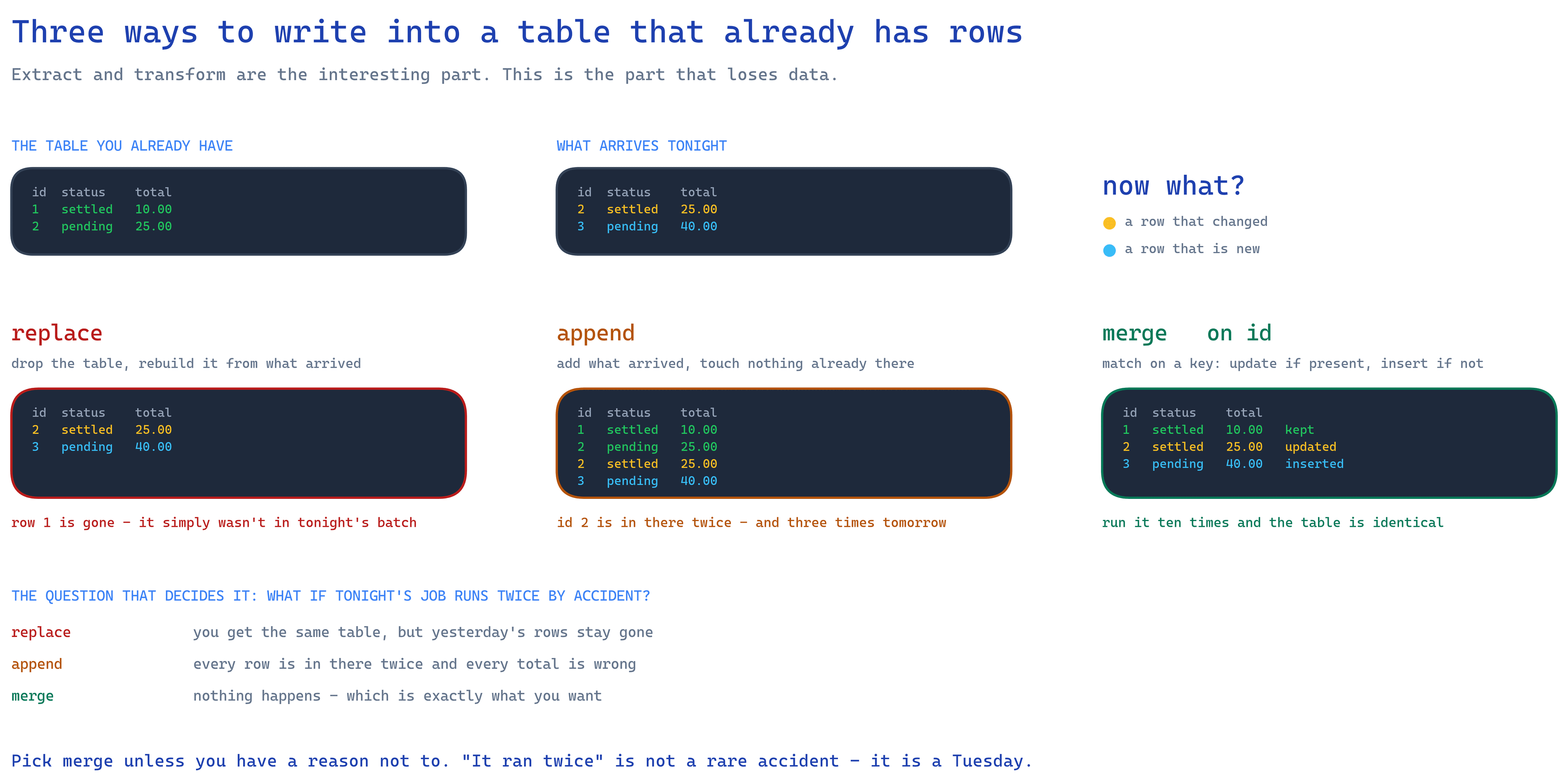
Section titled “Loading: the three strategies”Getting data in looks trivial - write the rows - until a run fails halfway or runs twice. Then the load strategy decides whether you’re fine or double-counted:
- Replace (full refresh’s partner): delete the old, write the new - atomically, so readers never see a half-written table (the classic trick: write to the side, then swap). Run it twice and nothing is harmed.
- Append: add new rows to the end. The natural partner of incremental extraction - and the dangerous one, because a retried run appends again. Ask what happens if the same batch arrives twice before choosing append.
- Merge (also called upsert): the smart middle. Each incoming row either updates the
existing row with the same key (
order_id) or inserts a fresh one. Run it twice and the second pass overwrites rows with identical values - harmless.
Delivery guarantees: the honest vocabulary
Section titled “Delivery guarantees: the honest vocabulary”How sure are you that each source row ends up in the destination exactly once? Three levels:
- At-most-once: never duplicated, but may be lost. (Fire and forget.)
- At-least-once: never lost, but may be duplicated - this is what retries naturally give you. Appending with retries is at-least-once.
- Exactly-once: never lost, never duplicated - and, in its pure form, famously impossible to fully guarantee across independent systems that can each crash mid-step.
The practical resolution is effectively-once: allow redelivery (at-least-once) but make the load idempotent so duplicates are harmless. Merge and replace do exactly this - the second delivery of order 8231 just overwrites order 8231. This one idea - retry freely, load idempotently - is the closest thing ingestion has to a golden rule, and it’s why serious tools make you consciously opt in before pairing incremental extraction with a plain append.
Sunrise Bakery’s ingestion, assembled
Section titled “Sunrise Bakery’s ingestion, assembled”Nightly at 06:00: the Postgres connector pulls orders incrementally on updated_at
(watermark advanced only after the night’s loads commit), the CRM and payments connectors
page through their APIs with backoff-and-retry, everything lands as raw Parquet in dated
folders, and the analytics tables are loaded with replace (small tables) and merge on
order_id (orders). A retried run changes nothing but timestamps. That’s the whole
article in one paragraph.
The takeaway
Section titled “The takeaway”- Connectors turn source-wrangling into configuration; be gentle with sources - extract incrementally, push filters down, back off when throttled.
- Retry transient failures with backoff; fail fast and loud on permanent ones.
- Land raw data, prefer Parquet at rest, and decide your schema-drift posture explicitly.
- Choose the load strategy by asking “what if this ran twice?” - merge and replace shrug; append double-counts.
- Aim for effectively-once: at-least-once delivery on top of idempotent loads.
Next: 5. Transforming data