6. Orchestrating pipelines
Article 5 left us with a pile of small, well-behaved SQL steps. Now someone has to run them - in the right order, at the right time, restarting the right pieces when something fails. That job is orchestration, and it’s the difference between “a folder of scripts” and “a system.”
Order is not optional
Section titled “Order is not optional”Think about cooking from a recipe: you can chop the onions and preheat the oven in either order (or at the same time), but you cannot frost the cake before baking it. Steps have dependencies, and dependencies are one-directional.
Sunrise Bakery’s steps are the same. stg_orders can’t run until raw orders are extracted;
orders_enriched needs all three staging tables; the two revenue marts need
orders_enriched; the dashboard tables shouldn’t be written until their mart is built. Run
them out of order and you get, at best, a crash - at worst, a report quietly built from
yesterday’s half of the data.
The DAG: the shape of every pipeline
Section titled “The DAG: the shape of every pipeline”Write down each step as a dot and each “must finish before” as an arrow and you get the central object of orchestration: a directed acyclic graph, or DAG.
- Directed: arrows point one way - from producer to consumer.
- Acyclic: no loops. If A needs B and B needs A, nothing can ever start. A cycle in a pipeline definition is always a bug, and good tools refuse it outright.
- Graph: dots and arrows.
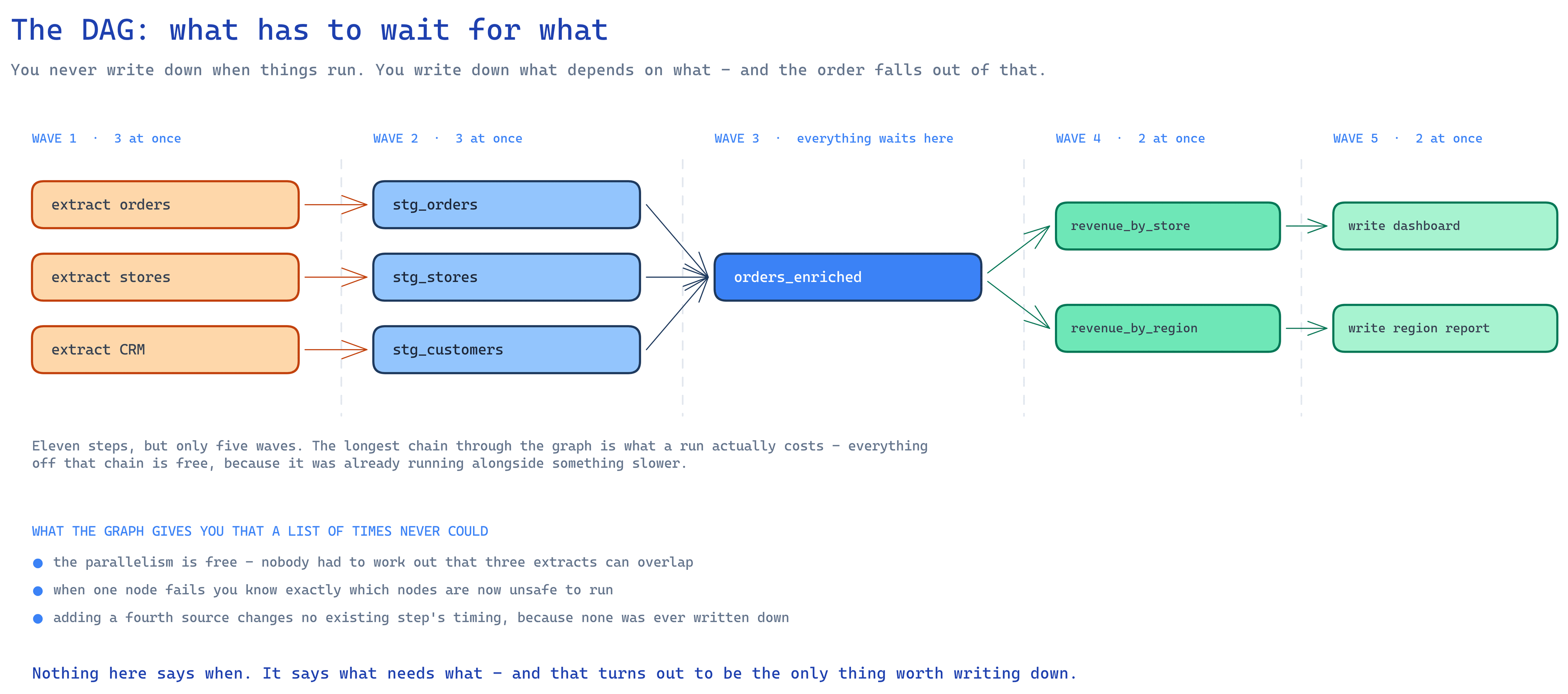
The DAG earns its keep three ways:
- Correct order, computed not memorized. The orchestrator sorts the graph (topological order) so every step runs only after its dependencies. Nobody maintains a fragile numbered list; add a step and its arrows, and the order updates itself.
- Free parallelism. The three extractions share no arrows, so they can run simultaneously. The graph exposes exactly what’s parallelizable - no analysis needed.
- Surgical failure handling. If
stg_storesfails, the orchestrator knows precisely what’s downstream of it (orders_enrichedand everything after - skip) and what isn’t (stg_orders,stg_customers- carry on fine). One bad step no longer poisons the whole night.
Where does the DAG come from?
Section titled “Where does the DAG come from?”Two schools:
- Declare it by hand: a config file listing “task A, then B, then C.” Explicit, but it drifts - you edit the SQL to join a new table and forget to add the arrow, and the graph silently lies.
- Derive it from the code: each SQL step names its inputs - “I read from
stg_orders” - and the tool assembles the graph from those references. The dependency can’t drift because it is the code. This is the modern default (dbt’sref()made it famous;pzworks the same way), and it’s a big deal: the graph is always exactly as true as the SQL.
Scheduling: when does it all start?
Section titled “Scheduling: when does it all start?”The scheduler answers when; the DAG answers in what order. Keep the two jobs separate in your head - many teams run a very fancy DAG off a very plain scheduler, and that’s healthy.
- Cron - the 50-year-old Unix scheduler (“at 06:00 daily, run this command”) and its siblings (Windows Task Scheduler, systemd timers, a CI job on a timer). If your pipeline is one command that internally runs the whole DAG, cron-plus-that-command is a complete, honest orchestration setup for a small team.
- Orchestration platforms - Airflow, Dagster, Prefect and friends. These earn their operational cost when you outgrow one command: many pipelines with cross-pipeline dependencies, event-driven triggers (“run when the file arrives”), a UI for a team to watch and rerun things, per-task alerting.
- Event triggers - don’t run at a time; run when something happens. Batch stays batch; only the starting gun changes.
The trap to avoid is resume-driven orchestration: installing a distributed scheduling platform to run what is, honestly, one nightly command. Complexity is a cost you pay every day; pay it when the pain arrives, not before.
Failure is normal: retries, skips, and resumes
Section titled “Failure is normal: retries, skips, and resumes”Orchestration’s real job description is “what happens at 3 a.m. when step 7 of 12 dies.”
- Retries with backoff (article 4’s logic, now applied per step): transient blips heal themselves before anyone wakes up. Cap the attempts; a source that’s down all night should fail the step, not retry until sunrise.
- Skip downstream, finish the rest: everything not depending on the failure completes normally. Half a warm dashboard beats a cold one.
- Resume from failure: this is the feature to demand. When the CRM extraction died at step 9, rerunning the night should redo step 9 and what follows - not re-extract three sources and rebuild six tables that already succeeded. Tools that remember “what already landed safely” turn a 40-minute rerun into a 4-minute one, and remove all temptation to “just quickly patch it by hand” (the way pipelines get corrupted).
- Concurrency limits: parallelism is free in the graph but not in the world - eight simultaneous extractions can flatten a small source database. Good orchestration lets you cap how many steps hit one system at once.
- A circuit breaker for the truly bad night: if half the steps are failing, stop starting new ones. When the database is down, forty failure emails are not forty times more informative than one.
Backfills, revisited
Section titled “Backfills, revisited”Article 3 said backfills should run as bounded slices. Orchestration is where that becomes real: rebuilding 2024 means running the same DAG many times with different date windows - January, then February, then March. The orchestrator’s contribution is pacing (one slice at a time, gently), retrying failed slices individually, and tracking which slices are done. Same graph, different question.
Sunrise Bakery, orchestrated
Section titled “Sunrise Bakery, orchestrated”Their complete setup: every file from article 5 declares what it reads, the tool derives the
DAG, and one crontab line - 0 6 * * * pipeline run - starts the night. Extractions run in
parallel (capped at two against the shop database), a failed CRM pull retries twice with
backoff, and the morning after a real failure, one resume command redoes only what’s
missing. Nobody maintains an order. Nobody reruns the world.
The takeaway
Section titled “The takeaway”- Dependencies form a DAG; the orchestrator sorts it, parallelizes the independent parts, and contains failures to their downstream cone.
- Derive the graph from the code’s own references - hand-declared graphs drift.
- When (scheduler) and in what order (DAG) are separate jobs; cron plus a DAG-aware tool is a legitimate architecture, not a hack.
- Judge orchestration by its worst night: retries for blips, skips for containment, resume-from-failure for the morning after.