Data plane
This page is for contributors. It explains how bytes physically move through pz: why DuckDB
is the hub, the two tiers a connector’s data can travel on, why Arrow RecordBatch is the one
canonical in-memory format, and the ownership rules that keep the zero-copy path safe.
DuckDB is the hub
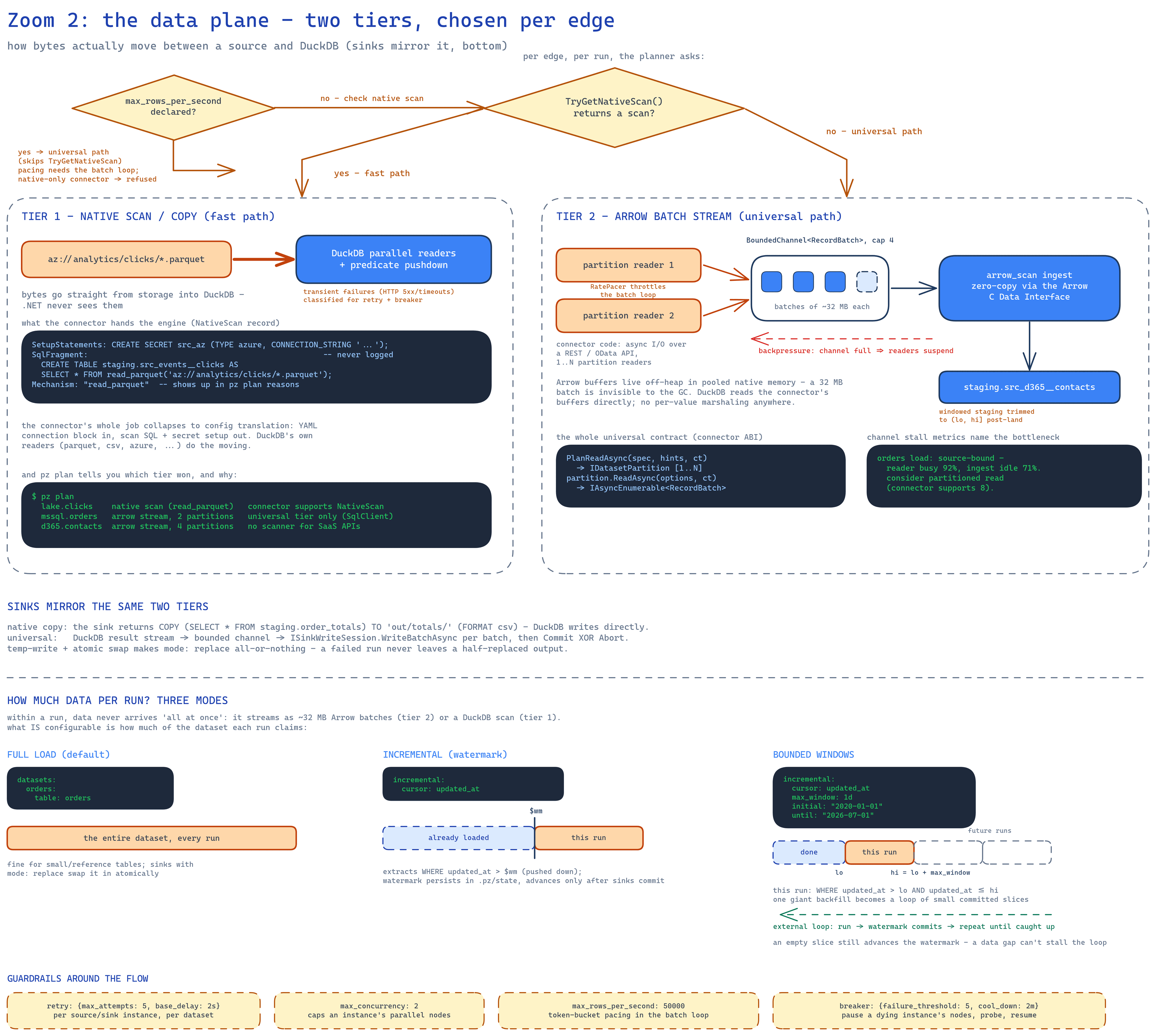
Section titled “DuckDB is the hub”Sources land data into a DuckDB staging database, SQL pipelines transform it inside DuckDB, and sinks drain results out. The engine never tries to be a buffer manager. DuckDB is the buffer manager:
- Staging is a disk-backed DuckDB database file (
.pz/runs/<id>/staging.duckdb), not:memory:. DuckDB spills cold data, and its out-of-core operators handle datasets far beyond RAM, governed by itsmemory_limit. - The .NET side holds only in-flight batches:
bounded_channel_capacity × batch_bytes × concurrent_nodes, a small, predictable, configurable number. - Sink egress streams: DuckDB result to Arrow batches to sink writer. Nothing is ever fully materialized in managed memory.
Tier 1: native scan and copy
Section titled “Tier 1: native scan and copy”On the native tier, the connector returns a DuckDB SQL fragment plus setup statements, for
example read_parquet('s3://bucket/path/*.parquet') and a CREATE SECRET statement. Data
never enters .NET memory; DuckDB pulls directly, or pushes via COPY TO. The connector’s job
reduces to configuration translation, and this is the fastest possible path. Setup statements
run once per run, not once per node: the engine keys them by exact statement text, so every
node that needs the same extension load, secret, session setting, or attach shares one execution,
concurrent nodes await the one in flight, and a statement that failed is re-issued when the node
retries. MotherDuck depends on this, since its extension accepts a token only before its first
attach. A connector
declares this on the read side with ConnectorCapabilities.NativeScan
(ISource.TryGetNativeScan) and on the write side with NativeCopy (ISink.TryGetNativeCopy).
The planner chooses the tier per edge, per run, prefers the native path, and logs which
tier each edge used. pz plan shows the choice and the reason before anything runs.
Tier 2: the universal Arrow path
Section titled “Tier 2: the universal Arrow path”The universal tier is an async stream of Arrow RecordBatches, produced by a source connector
or consumed by a sink connector. It works for any system: SaaS APIs, message queues drained as
batches, proprietary databases. It is the path the engine’s internals optimize.
Arrow RecordBatch is the one canonical in-memory format, for four reasons:
- Zero-copy into and out of DuckDB. DuckDB natively consumes Arrow streams via the C
Data Interface (
ArrowArrayStream) as a table scan and exports query results as Arrow. Ingest becomes a scan over the connector’s own buffers, with no per-value marshaling. - Columnar batches amortize everything. Type dispatch happens once per column per batch instead of once per value, conversion vectorizes, and layouts are SIMD-friendly.
- Off-heap memory. Arrow buffers live in native memory from a pooling allocator. A 64 MB batch is invisible to the GC; the managed heap stays small.
- It is the industry interchange standard. ADBC drivers, Arrow Flight, Parquet, and every modern engine speak it, so out-of-process connectors and distributed execution are transport changes, not format changes.
Row-based edges are embraced, not denied. Most OLTP wire protocols are row-oriented anyway, so
Pz.Connectors.Abstractions ships batteries: an ArrowBatchBuilder for pooled, allocation-free
column builders, and a DataReaderSource that wraps any DbDataReader into an Arrow batch
stream, so an ADO.NET-backed connector is around 50 lines. The row-to-column pivot happens once,
at the edge, into pooled native buffers, the only place row orientation touches the system.
Batch sizing is byte-targeted, not row-targeted: engine.batch_bytes defaults to about
32 MB and is configurable, with rows per batch also capped to keep DuckDB’s vectors well-fed.
Batch ownership
Section titled “Batch ownership”Tier selection: engine.force_universal and PZ0312
Section titled “Tier selection: engine.force_universal and PZ0312”engine.force_universal in project.yml is an escape hatch that forces the universal tier
even when a native scan or copy is available, useful for debugging or working around a native-
path bug. Some connectors have no universal route at all for a given edge: they implement the
empty marker interface INativeOnlySource or INativeOnlySink, which tells the planner there
is nothing to fall back to.
When a run asks for the universal tier on an edge that can’t provide one, the planner refuses the combination outright rather than planning “successfully” onto a partition or write-session call that would only fail once the run reached it:
| Connector | Native-only reads | Native-only writes |
|---|---|---|
mysql |
Yes (DuckDB mysql extension is the whole data plane) |
Yes |
sqlite |
Yes (DuckDB sqlite extension is the whole data plane) |
Yes |
duckdb |
Yes (the engine’s own session attaches the file) | Yes |
ducklake |
Yes (DuckDB ducklake extension is the whole data plane) |
Yes |
motherduck |
Yes (DuckDB motherduck extension is the whole data plane) |
Yes |
quack |
Yes (DuckDB quack extension is the whole data plane) |
Yes |
iceberg |
Yes (DuckDB iceberg extension is the whole data plane) |
Yes |
s3 |
No, but native both directions; force_universal still refused |
No |
azureblob |
Yes | No, writes run either tier (partition_by fan-out needs the universal tier) |
gcs |
Only under hmac auth; service_account/adc are write-only, universal-tier |
No |
postgres, sqlserver, and http have no native tier at all, so force_universal is moot
for them. Requesting the universal tier where it doesn’t exist, whether via
engine.force_universal or via a universal-only dataset option like files_per_partition on a
native-only connector, is PZ0312, naming the option, dataset, and connector.
Larger than memory
Section titled “Larger than memory”Because staging is disk-backed and the .NET side only ever holds in-flight batches, a dataset
larger than RAM is the default case, not a special mode. DuckDB’s memory_limit governs spill;
the engine’s own memory use stays bounded by the channel formula above.
Related
Section titled “Related”- Architecture: where the data plane fits in the layering.
- Execution internals: the dispatcher and channels that drive it.
- Connector architecture: the ABI a connector implements to feed it.
- Connectors: the user-facing view of native vs universal tiers.