Architecture
This page is for someone working on pz itself, not using it. It covers the design principles
behind the engine, how the pieces fit together, and the layering every project in the solution
follows. If you’re looking for how pz behaves as a user, start at
Key concepts instead.
Design principles
Section titled “Design principles”- Configuration as code. The entire pipeline definition lives in versionable text files.
- SQL-first. Transformations are DuckDB SQL files, not C# code.
- Deterministic and reproducible. Pinned connector versions, a lock file, rendered artifacts, and stable node identities. Same project plus same inputs means same behavior.
- The CLI is the product. Connectors ship independently as NuGet packages. The CLI discovers, validates, and executes them through a stable ABI.
- Performance is a feature. Columnar, zero-copy where possible, larger-than-memory by default, allocation-conscious.
- Transparent execution. A contributor or an operator can always answer “what is it doing right now, and why is it slow?”
How the pieces fit
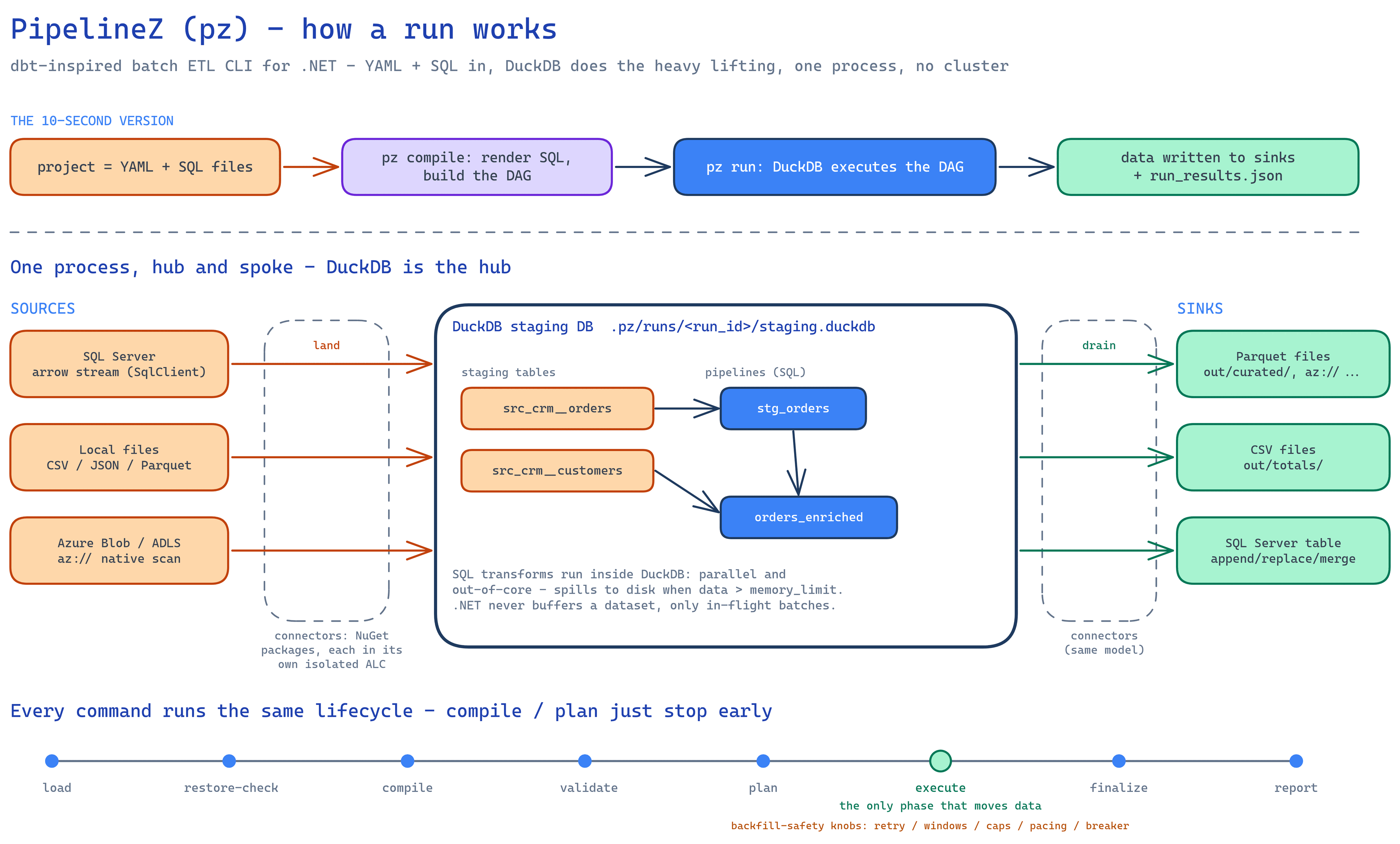
Section titled “How the pieces fit”PipelineZ is a hub-and-spoke engine with DuckDB as the hub. Sources land data into a
DuckDB staging database, SQL pipelines transform it inside DuckDB, and sinks drain results
out. Builtin connectors are compiled straight into the CLI; every other connector is a NuGet
package that pz restore pins and that runs as its own out-of-process connector, spawned
and driven over a small wire protocol (PCP). The CLI process never loads third-party code
in-process. See Connector architecture.
Two capability-gated resume mechanisms sit underneath the run loop, one on the read side and
one on the write side: a source that declares StablePartitionIds lands each partition into
its own part table instead of a shared ingest stream, and a sink that declares
CheckpointableWrites gets an engine-owned delivery ledger tracking how many rows the
destination has durably confirmed. Both are covered in full, with the actual table names and
schema, in Resume internals.
Layering
Section titled “Layering”Layering is strictly downward: a project may only reference the ones below it in this table.
| Project | Responsibility |
|---|---|
Pz.Cli |
Verbs, argument parsing, console rendering, exit codes. Thin; real work is delegated down. |
Pz.Core |
Project model, YAML/SQL parsing, Scriban template rendering, DAG compilation, validation. |
Pz.Engine |
Dispatcher, node executors, retries, run artifacts, watermark and sync-state stores. |
Pz.DuckDb |
Thin interop layer over the DuckDB C API: Arrow ingest/export, query, EXPLAIN. |
Pz.PackageManagement |
In-process NuGet resolution, the lock file, connector materialization, and the out-of-process connector host (PCP). |
Pz.Connectors.Abstractions |
The connector ABI: the contract of the whole ecosystem. References Apache.Arrow only. |
Pz.Connectors.Protocol |
Generated gRPC/protobuf code for the PCP wire format. Not a connector-authoring surface. |
Pz.Connectors.TestKit |
The acceptance and contract test suite every connector, builtin or external, runs against. |
Pz.Connectors.Toolkit |
Shared connector mechanism (format codecs, HTTP paging, auth, {{ binding }} expansion, transient-error classification) for builtin connectors. An ordinary transitive dependency, not part of the ABI. |
Pz.Diagnostics |
One typed event stream; console and NDJSON renderers, plus OpenTelemetry plumbing, are views over it. |
Pz.Mcp |
The pz mcp server: typed tools for introspection, verification, authoring, and docs. Run-triggering tools require --allow-run. |
Pz.State.Http |
A pluggable state backend: keyed watermark/sync-state storage over a server’s run-scoped HTTP endpoints. |
Pz.State.SqlServer |
A pluggable state backend over SQL Server, with schema creation, migration, and batched run-artifact persistence. |
connectors/ |
The fifteen first-party connectors: LocalFiles, Postgres, S3, SqlServer, AzureBlob, Gcs, Http, MySql, Sqlite, Sftp, DuckDb, DuckLake, Quack, MotherDuck, Iceberg. |
The Abstractions assembly is the contract of the whole ecosystem. It changes under a
strict additive-only compatibility policy: growth happens through new optional capability
interfaces and new ConnectorCapabilities flags, never through a breaking change to an
existing interface. Growth stays forward-compatible at the wire level too: a connector built on a
newer SDK than a given pz’s own Abstractions may declare a capability bit that build doesn’t
define, and the host treats that as a one-time warning rather than a handshake failure, masking
the unknown bit out before comparing or naming capabilities. See
Connector architecture.
The two-tier data plane
Section titled “The two-tier data plane”DuckDB already ships world-class readers and writers: Parquet, CSV, JSON, httpfs/S3,
extensions for Postgres, MySQL, SQLite, and Azure. Streaming those bytes through .NET row by
row when DuckDB can scan them directly would waste that. So the data plane has two tiers,
chosen per edge, per run, by the planner: a native scan/copy where the connector hands DuckDB
a SQL fragment, or the universal Arrow batch stream that works for any system. The full story,
including batch ownership rules and the engine.force_universal escape hatch, is in
The data plane.
What’s shipped and what’s next
Section titled “What’s shipped and what’s next”Everything above is shipped, including incremental processing (unbounded watermarks and
bounded backfill windows) and change data capture, which lands change batches with op-type
columns that DuckDB merge pipelines consume. What the architecture still grows toward without
a rewrite: distributed execution (plan.json is already a serializable DAG of content-hashed
nodes; Arrow Flight would replace in-process channels between workers), deeper orchestration
integration (manifest.json and selectors already map onto the way dbt integrations generate
tasks), and column-level lineage (the manifest is already table-level lineage; DuckDB’s own SQL
parser can derive column-level lineage from already-rendered SQL).
Related
Section titled “Related”- Key concepts: the user-facing vocabulary this page assumes.
- The data plane: the two tiers in full, with tier-selection rules and PZ0312.
- Execution internals: the compiler, the planner, and the dispatcher.
- Resume internals: the ledgers and checkpoints behind
pz retry. - Connector architecture: the ABI, PCP, and the builtin registry.